How to Ship Trading Cards Safely: Single Cards, Graded Slabs and Bulk Lots
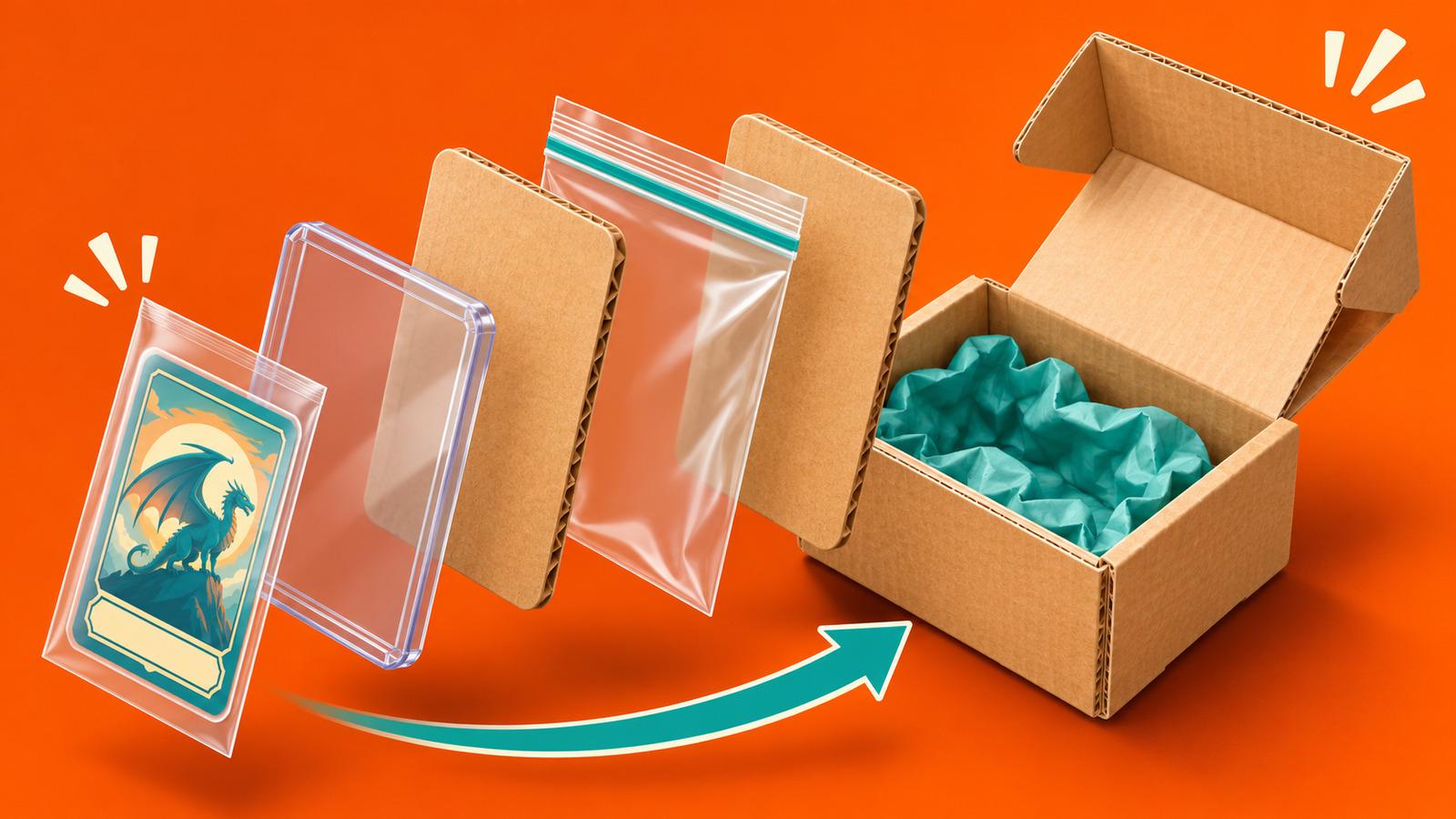
AI-created conceptual illustration of card-protection layers leading into a cushioned shipping box; not a carrier-certified packing method.
Build the package around the item, keep movement under control, and choose a shipping service that accepts the finished package.
Quick answer
Protect the card’s surface with compatible materials, stop it moving inside its holder and package, and use outer packaging suitable for the chosen shipping service. Raw cards, slabs and bulk lots need different arrangements. Weigh and measure the finished package, photograph the item before packing, and check current carrier or marketplace rules.
A strong holder does not solve every shipping problem. A card can slide out of an open holder, a slab can collide with another slab, and a carefully packed parcel can still be sent with the wrong postage or service.
Think in layers: protect the card, control movement, cushion the package where needed, and select the service for what you actually packed.
Choose the package for the item
| Item | Inner protection | Outer packaging approach |
|---|---|---|
| Single raw card | Compatible sleeve and protective holder; secure the opening | An eligible envelope setup or padded parcel, depending on service rules and value |
| Graded slab | Clean protective bag and cushioning | A suitable padded parcel; use a box when more protection is needed |
| Several slabs | Protect and separate each slab | Sturdy box with cushioning and controlled movement |
| Bulk cards | Supported card rows in a fitted inner box | Outer shipping box with padding around the inner box |
The table is a packing guide, not a carrier eligibility determination. Mailing dimensions, flexibility, value limits and compensation rules vary.
Packing recipe 1: a single raw card
 Schematic raw-card packing layers: compatible sleeve, protective holder, secured outer bag, and service-appropriate outer packaging. Tape stays away from the card.
Start with clear front and back photographs. Place the card in a correctly sized sleeve without catching its corners, then in a compatible protective holder. Check that the card cannot easily escape through the opening.
A resealable outer bag can help contain the holder. Keep adhesive away from the card and sleeve opening. Do not put a pull tab directly on the card. Any tape used on outer protection should be easy for the buyer to remove without cutting toward the card.
For parcel shipping, additional rigid protection may help prevent bending, provided it does not squeeze or damage the contents. For an envelope service, follow its specific flexibility and thickness rules. A bulky rigid sandwich that works in a parcel may make an envelope ineligible.
Can you use eBay standard envelope?
eBay offers a standard-envelope service for eligible items, including qualifying trading-card shipments. Check the current category, value, dimensions, weight, flexibility and destination requirements before using it.
This article does not freeze those limits into a permanent packing recipe. The package must meet the current rules as packed, not just before you add cardboard, a holder or another card. A slab or bulky lot should not be assumed eligible because it belongs to a trading-card category.
eBay’s card-selling resource links the relevant seller tools. If the finished package does not meet an envelope service’s requirements, select an appropriate parcel service and price the listing accordingly.
Packing recipe 2: graded slabs
 Schematic parcel cross-section shows two separately protected slabs with cushioning around them and separation between hard surfaces.
Protect the holder from scuffs, then cushion it. When shipping more than one slab, separate them so hard plastic cannot strike hard plastic. Fit the wrapped contents into a suitable box without pressure on the slab faces.
Fill empty space so the items do not travel across the box during handling. Close the package and gently check for movement. Do not treat that check as proof against crushing or dropping; it only helps find loose contents.
Packing recipe 3: a bulk lot
 Bulk-shipping cross-section shows supported card rows inside an inner storage box, cushioning and an outer shipping box.
Keep cards in supported rows inside a fitted card box. Avoid rubber bands around bare cards and do not compress the stack to make the lid close. Use dividers or compatible filler to stop a partially filled row from collapsing.
Place the card box inside an outer shipping box with cushioning. A storage box that sits safely on a shelf is not necessarily a sufficient shipping container. Record the lot contents and retain photographs of the packing arrangement.
The final check happens after packing
Measure the final package and include all packaging in the weight. Confirm the destination, tracking arrangement and the service’s treatment of collectibles. If the item needs insurance or declared-value coverage, read the exclusions, evidence requirements and claim limits. Do not assume a purchased amount guarantees a claim will be paid.
Keep the acceptance receipt or other dispatch evidence provided by the service. Packing photographs and condition records can support documentation, but they do not guarantee an outcome in a loss or damage dispute.
Match the listing to the card you actually send
Use photographs of the actual copy, describe visible flaws and send the version named in the listing. A DCM report can document the condition shown in its assessment images; it is not shipping insurance or proof of the package’s contents.
Our eBay condition guide explains accurate descriptions, and InstaList’s workflow covers creating the listing. Good shipping completes that work by giving the card a better chance of arriving in the condition the buyer saw.
Shipping-service references reviewed November 2, 2026. Confirm current rules when buying postage.
Header artwork is an AI-created editorial illustration. Its fictional cards and scenes are not product references, condition-test results or authentication evidence.
Frequently asked questions
- Can I ship a trading card in a plain envelope?
- Only when the packed item meets the chosen service’s rules and that service suits the transaction. Check thickness, weight, flexibility, value and other eligibility requirements after packing.
- Should I tape the top of a toploader?
- Keep adhesive away from the card and sleeve opening. A compatible resealable outer bag can help contain the holder; any outer tape should be removable without risking the card.
- How do I ship several graded slabs?
- Protect and cushion each slab separately, prevent hard surfaces from touching, and use a sturdy outer package with the empty space controlled.
- Do packaging photos guarantee a shipping claim?
- No. They can support documentation, but coverage and claim outcomes depend on the service’s terms, exclusions and required evidence.