eBay Card Condition Guide: What Near Mint, Excellent, LP and MP Actually Mean
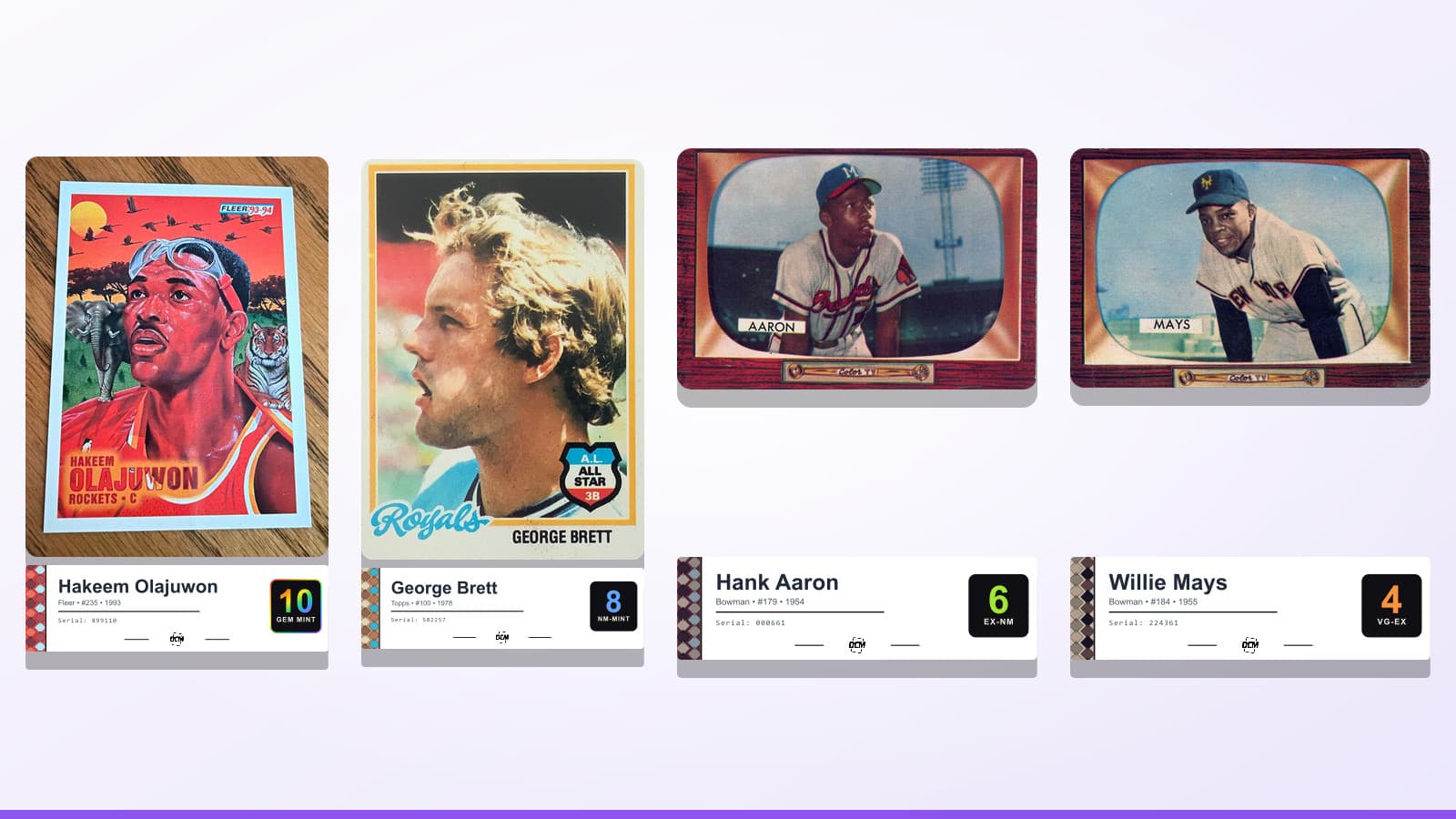
Four DCM graded cards from 10 down to 4: 1993 Fleer Hakeem Olajuwon 10, 1978 Topps George Brett 8, 1954 Bowman Hank Aaron 6, 1955 Bowman Willie Mays 4
eBay's four ungraded conditions, the TCG terms that map to them, the numeric grades behind each, and how to list a raw card so it does not come back.
Quick answer
eBay's ungraded trading card conditions are Near Mint or Better (TCG: Near Mint, roughly grades 8 to 10), Excellent (Lightly Played, roughly 6 to 7), Very Good (Moderately Played, roughly 4 to 5) and Poor (Heavily Played or Damaged, roughly 1 to 3). Near Mint or Better allows at most minor flaws such as slight corner or edge chipping. The numeric ranges are the common hobby mapping, not an eBay rule, and a DCM grade with a linked report settles which band a raw card belongs in.
eBay moved trading cards from "New" and "Used" to "Graded" and "Ungraded", and gave ungraded cards four conditions to choose from. Sellers guess at them, buyers argue about them, and a lot of returns start with the gap between the word in the listing and the card in the mailer.
Here is what each term means, the TCG vocabulary that maps to it, and what the bands look like on real cards.
The four eBay conditions
 Table mapping eBay condition terms and TCG terms to numeric grade ranges
| eBay condition | TCG term | Typical numeric grade | What it looks like |
|---|---|---|---|
| Near Mint or Better | Near Mint (NM) | 8 to 10 | Sharp corners, clean edges, at most a tiny flaw that needs light to find |
| Excellent | Lightly Played (LP) | 6 to 7 | Light corner wear or edge whitening, no creases |
| Very Good | Moderately Played (MP) | 4 to 5 | Obvious wear, scuffing, possibly a light crease |
| Poor | Heavily Played (HP) / Damaged | 1 to 3 | Creases, tears, writing, water damage or heavy wear |
eBay's own tables grade corners, edges, creases, scratches and staining for each tier. The thing sellers miss is that Near Mint or Better still allows minor flaws, such as minor chipping on corners and edges, which is why a buyer who expects a perfect card from "Near Mint" is sometimes disappointed. The numeric ranges are the common hobby mapping, not an eBay rule; eBay uses words, not numbers, for ungraded cards.
What each band looks like
The header image shows four cards graded on DCM, one for each band:
- 1993 Fleer Hakeem Olajuwon, DCM 10: Near Mint or Better. Every category 10 on both faces.
- 1978 Topps George Brett, DCM 8: still Near Mint or Better, but at the bottom of it. Light handling on the corners, edges and surface; centering 9.
- 1954 Bowman Hank Aaron, DCM 6: Excellent, or Lightly Played. Noticeable whitening at the bottom-left corner, edges at 6, surface 8, centering 10.
- 1955 Bowman Willie Mays, DCM 4: Very Good, or Moderately Played. Corners 4, edges 5, surface 6. A vintage card that has been handled for seventy years.
Notice that the Aaron and the Mays have perfect centering. Condition terms describe the worst thing about a card, not the average, which is also how weakest-link grading works.
Why the word and the photo disagree
Three reasons, in order of how often they cause a return:
- The seller graded by eye in bad light. A soft corner is invisible under a ceiling light and obvious under a lamp. The lighting guide is the fix.
- The seller used the pack-fresh assumption. Cards come out of packs with print lines, edge chips and soft corners. "Pack fresh" is not a condition.
- The seller priced a raw card at a graded price. A raw "Near Mint" card and a graded 9 are different products with different comps. How to find out what your cards are worth covers matching the condition to the comp.
How to list a raw card so it does not come back
 Two-column graphic: what a trusted card listing includes and what gets a listing returned
- Photograph the actual card, front and back, in even light. No stock images. Add close-ups of the corners.
- Grade it before you pick the condition. A DCM grade for $2.99 or less gives you the four subgrades and a written list of every flaw. An 8 is Near Mint or Better; a 7 is Excellent. The report takes the guess out of the dropdown.
- Name every flaw in the description. "Light whitening on the back bottom edge" sells more cards than it loses, because the buyer who cares reads it and the buyer who does not keeps the card.
- Link the report. A public DCM report page shows the buyer the photos that were graded and the reasons, which is the most persuasive condition statement a raw listing can carry.
- Use the term that matches the photos, not the one that matches the price you want.
DCM's InstaList builds the eBay listing from the report, with the grade, the subgrades and the photos attached, and a footnote that the card is not slabbed. Listing graded cards on eBay walks through it.
eBay condition names are from eBay's trading card listing categories as of October 2026. The numeric grade ranges are the common hobby mapping and not an eBay policy. DCM grades document condition against a published standard and do not authenticate cards.
Frequently asked questions
- What does Near Mint or Better mean on eBay?
- eBay's top condition for ungraded trading cards. It allows at most minor flaws, such as slight chipping on corners and edges, so it is not a promise of a perfect card. In numeric terms it covers roughly grades 8 to 10. The TCG equivalent is Near Mint (NM).
- What is the difference between Lightly Played and Moderately Played?
- Lightly Played (eBay: Excellent) means light corner wear or edge whitening with no creases, roughly a 6 or 7. Moderately Played (eBay: Very Good) means obvious wear, scuffing and possibly a light crease, roughly a 4 or 5.
- Does eBay use numeric grades for ungraded cards?
- No. eBay uses four words for ungraded cards: Near Mint or Better, Excellent, Very Good and Poor. Numeric grades apply only to cards graded by a grading company. The number ranges in this guide are the common hobby mapping between the two.
- How do I avoid returns when selling raw cards on eBay?
- Photograph the actual card front and back in even light with corner close-ups, grade it before choosing the condition, name every flaw in the description, link a public report, and use the condition term that matches the photos rather than the price you want.