Grade your cards, track your portfolio, create custom labels and prepare eBay listings. Explore everything DCM brings to your collection, without mailing your cards away.
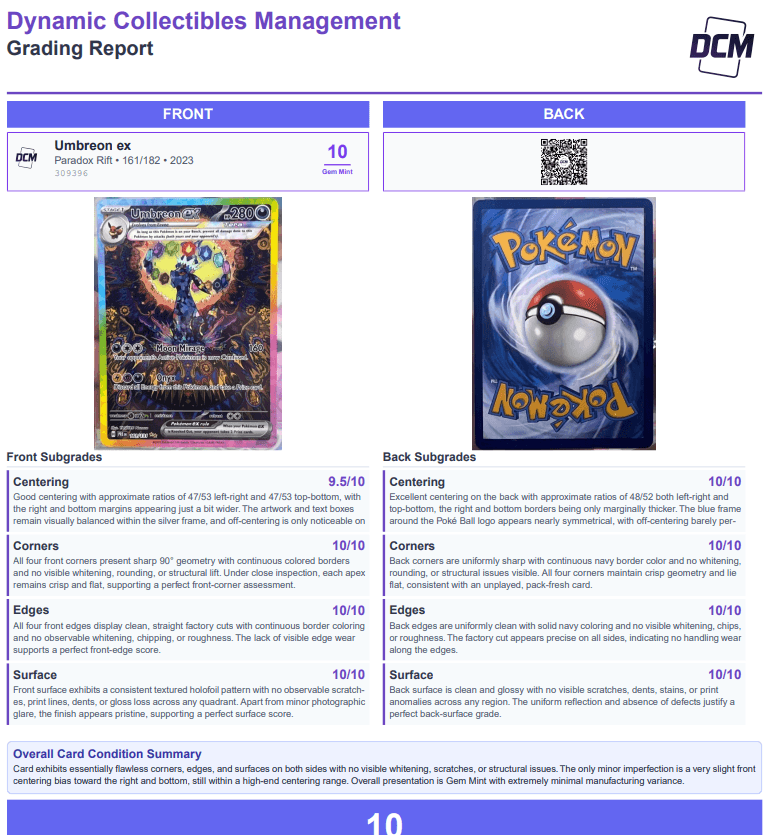
DCM identifies the card and evaluates the front and back with DCM Optic. The report connects a whole-number grade to the details visible in your photos.
Card identification
Identify the card name, set, number and relevant variant details. Supported card databases help distinguish cards across sports and major trading card games.
Centering
Assess the balance of the printed borders and alignment on the front and back.
Corners & edges
Review corner wear, whitening, edge damage and other visible condition issues.
Surface
Look for visible scratches, print issues, creases and surface wear. Photo clarity and glare affect what can be assessed.
A grade with an explanation
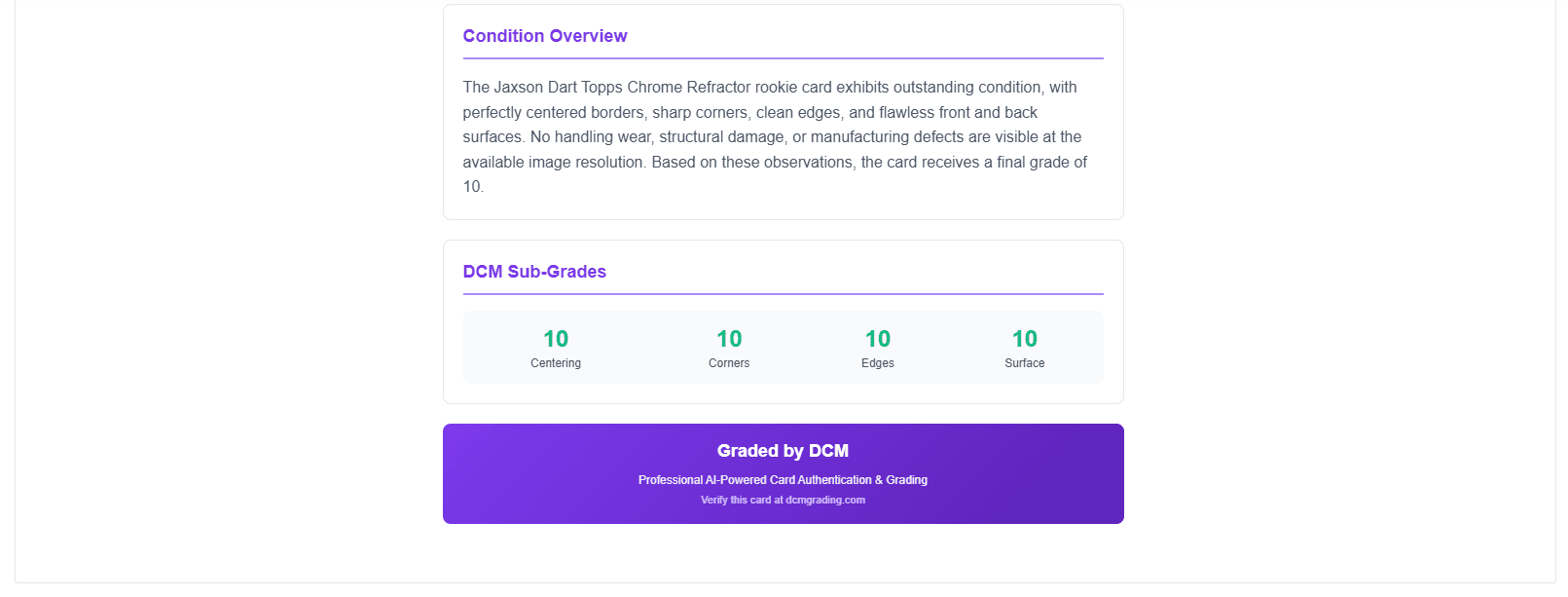
The final grade follows DCM’s published standard, with centering, corners, edges and surface subgrades and supporting findings.
Your portfolio brings graded cards and available market pricing together, with breakdowns that help you understand what you own and where its value sits.
Collection value & individual estimates
Review available card values and your portfolio total. See which cards have pricing available and which still need a market estimate.
Category, grade & value breakdowns
Explore the mix of sports and trading card games, how grades are distributed, and the spread of card values.
Most valuable cards & top sets
See which cards and sets contribute the most value to your collection.
Grade and value relationships
Compare value by grade, grade versus value, and value changes since grading.
Pricing sources
Review available pricing from sources such as PriceCharting, eBay and Scryfall, with the source information shown in the portfolio.
Example data shown. Sign in to explore the values and grade distribution of your own collection.
Your collection stays connected.
Open a card from your collection to revisit its report, download labels or prepare it for sale. Grading records, card images and collection tools stay together.
Choose both the design of your grading label and the format that fits your holder. Heritage is the site’s default, with Modern and Traditional styles also available in Label Studio.
Heritage
An ivory field, patterned color band and grade-colored chip. Match the band to your card or customize its palette; Gem Mint 10 uses the rainbow-outline treatment.
Modern
A dark label style with color and gradient controls for a different presentation.
Traditional
A classic light label style that keeps card identity and grading information easy to read.
Customize and preview
Choose a format, adjust the available style controls and preview the front and back before downloading.
Member badges
Eligible VIP and Card Lovers badges bring your membership identity onto supported grading labels.
Front and back labels for compatible grading slab cases. Keep the card identity, grade and verification details together.
Magnetic one-touch
A fold-over label for magnetic holders. Avery 6871 is the recommended template for the supported foldable label format.
Top loader
Compact label options for top loaders, including supported front/back and fold-over formats.
Digital display and print-ready downloads.
Create a graded card image for sharing online, or download your chosen label format to print. Report and label downloads are available to the account that graded the card. Match the template’s print size to your holder before applying it.
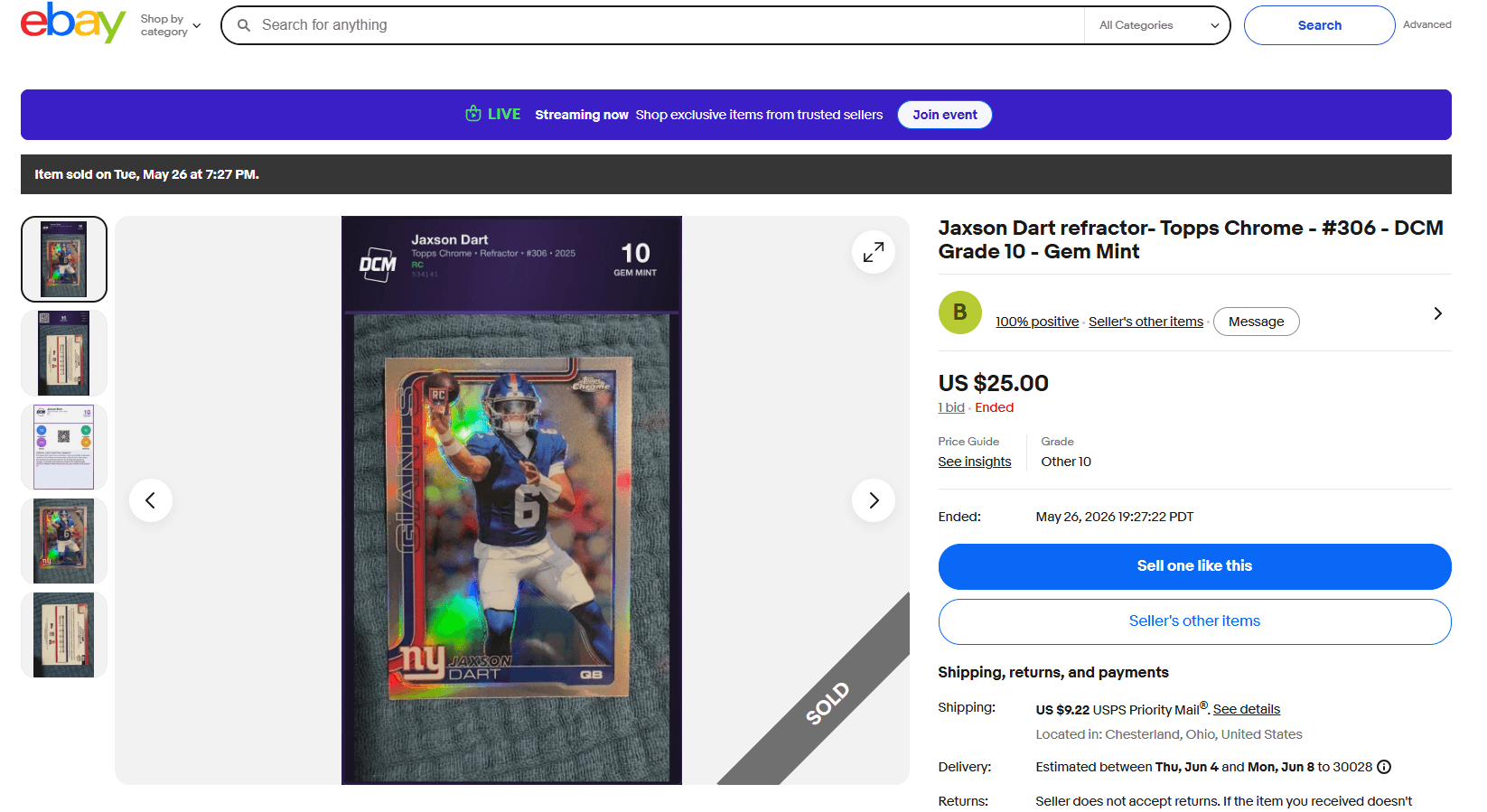
InstaList uses your card’s identification, images and grading report to prepare a listing, so you can give buyers the condition details you already have.
A prepared title and description
Build the listing from the card’s details, with a formatted description that includes the DCM grading breakdown.
Images built from your card
Use labeled front and back images, raw front and back photos, and a mini report to show the card and its assessment.
Condition and item specifics
Carry relevant grading and card information into eBay’s listing fields. Review the details before publishing.
Your sale format and price
Choose a supported fixed-price or auction format and set the terms of your sale.
Shipping options
Use the shipping tools to configure supported domestic and international delivery options.
The DCM grade summarizes the condition visible in your photographs. Open the report to review the four subgrades, findings and supporting evidence. Photo quality affects what can be assessed.
Share your public card report or serial number so another collector can review the recorded grade and condition analysis.
What if I disagree with my grade?
Review the report’s findings and photo evidence first. If glare or focus obscures a detail, take clearer photos. Contact support if something still looks wrong.