What Does "Image Confidence B" Mean? Reading a DCM Grade Report
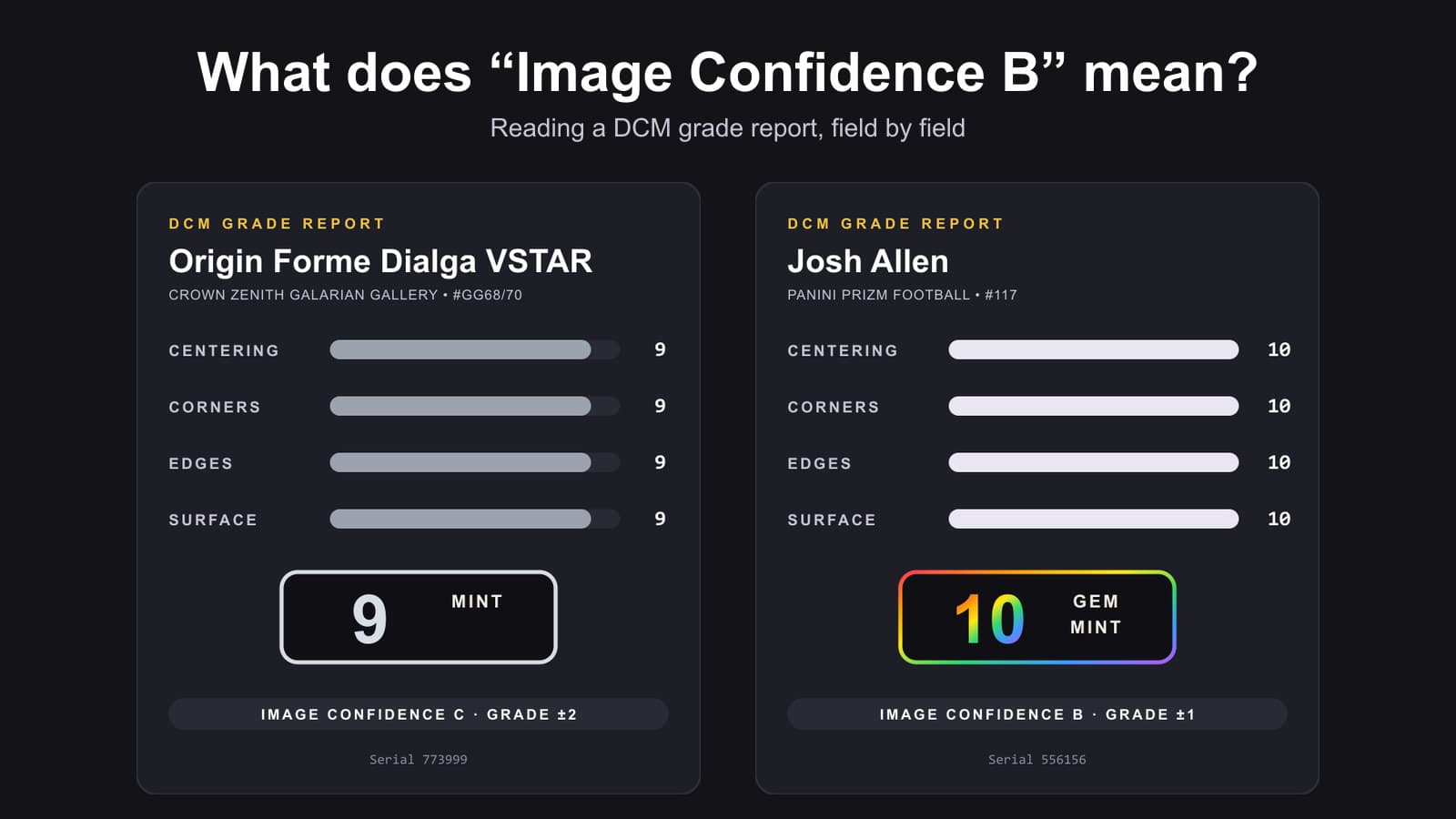
Two DCM grade reports side by side: a Dialga VSTAR at 9 with image confidence C and a range of plus or minus 2, and a Josh Allen at 10 with image confidence B and a range of plus or minus 1
Every DCM grade carries a confidence letter and an uncertainty range. Here is what they measure, why they exist, and how to use them.
Quick answer
Image confidence is a letter from A to D on every DCM grade report that rates how well your photos let DCM Optic see the card, paired with an uncertainty range such as plus or minus 1. An A means sharp, evenly lit photos of both sides. A B or C means glare, blur or framing limited the read, and the grade could move with better evidence.
Anyone can publish a number. Publishing how sure you are of the number is harder, and it is the part of a DCM report that people ask about most.
This is a field-by-field walkthrough of the report, with two real cards that show what a confident read and a less confident read look like.
The report, field by field
 A DCM grade report with four numbered callouts: card identity and serial, four subgrades, final grade equals the lowest subgrade, image confidence letter and uncertainty range
1. Card identity and serial. The name, set and number DCM Optic identified, and the serial that ties the report to a public page and a QR code.
2. Four subgrades. Centering, corners, edges and surface, each scored 1 to 10 from the front and back photos. These are the most useful numbers on the report, because they tell you which factor is doing the work.
3. Final grade. The lowest of the four subgrades. DCM grades on a weakest-link basis, so a card with three 10s and one 9 is a 9. Structural damage such as a crease caps the grade regardless.
4. Image confidence and uncertainty. Two things: a letter from A to D that rates how well the photos let the system see the card, and a range such as plus or minus 1 that says how far the grade could move with better evidence.
Why the confidence letter exists
Grading from photographs is not perfect, and any service that says otherwise is selling you something. Foil and gloss throw glare. A soft photo cannot resolve a corner. Uneven lighting hides a print line. Those are real limits, and they change how certain a read actually is.
So instead of hiding that, the report states it.
- A. Sharp, evenly lit, both sides fully in frame. The read is as good as photo grading gets.
- B. Good photos with a minor limit, such as slight glare on a foil or a soft corner. The most common result.
- C. Something in the photos meaningfully limits the read. The grade is held conservatively and the range widens.
- D. The photos are not good enough to grade reliably. Retake them before trusting the number.
Two real reports
Two DCM reports: Origin Forme Dialga VSTAR graded 9 with image confidence C and plus or minus 2, next to Josh Allen Prizm graded 10 with image confidence B and plus or minus 1
Josh Allen, Panini Prizm. Grade 10, confidence B, plus or minus 1. Clean photos, a small amount of Prizm glare, every subgrade a 10. The system reads the card as Gem Mint and says the true grade sits within one point.
Origin Forme Dialga VSTAR, Crown Zenith. Grade 9, confidence C, plus or minus 2. The report's own words: "The card presents at Gem Mint level, but the photos are not clear enough to confirm a 10, the grade is held at 9. Photo quality limits how confidently this card can be assessed."
That second sentence is the whole point. The card might be a 10. The photos could not prove it, so the grade was held at 9 and the range was widened to say so. A service that only printed "9" would be hiding the most useful fact about that card, which is that a retake could change it.
What to do with each letter
- A or B, narrow range. Trust the grade. Slab it, list it, price it.
- B with a subgrade you disagree with. Check the deduction sentence. If it names glare or a soft area, a retake under better light is worth a credit.
- C. Retake the photos before doing anything else. Diffuse light, no flash, both sides square to the camera. Our photography guide covers it.
- D. The grade is not usable yet. Retake.
Flagging what the camera cannot see
One more field worth knowing. At submission you can flag a defect you can see in hand that may not photograph, such as a crease that only shows on a tilt. DCM Optic takes that input into the analysis, and the report notes when a user report influenced the grade. The system handles the things a camera sees well, and you supply the context for the things it does not.
The number without the letter is a guess
A grade with no confidence level is a guess wearing a suit. The letter and the range are there so you can hold DCM to the standard you would hold any grader to: not just what did you decide, but how sure are you, and why.
Frequently asked questions
- What do the confidence letters mean?
- A: sharp and evenly lit, both sides fully in frame. B: good but with some glare, softness or cropping. C: meaningful limits on what could be seen. D: the photos could not support a reliable read.
- What is the uncertainty range?
- How far the grade could move if the card were photographed better. Plus or minus 0 means all evaluations agreed and the images were clear; plus or minus 1 means a neighbouring grade is possible.
- Should I regrade a card that got a B or C?
- Often yes. Reshoot both sides with even light, no sleeve and the full card in frame, then grade again. A better image usually moves the letter toward A and narrows the range.
- Can I tell DCM about a flaw the camera missed?
- Yes. During upload you can flag visible defects so the report has the right context for anything the photo does not show clearly.