What Is Weakest-Link Grading? Why One Subgrade Decides Everything
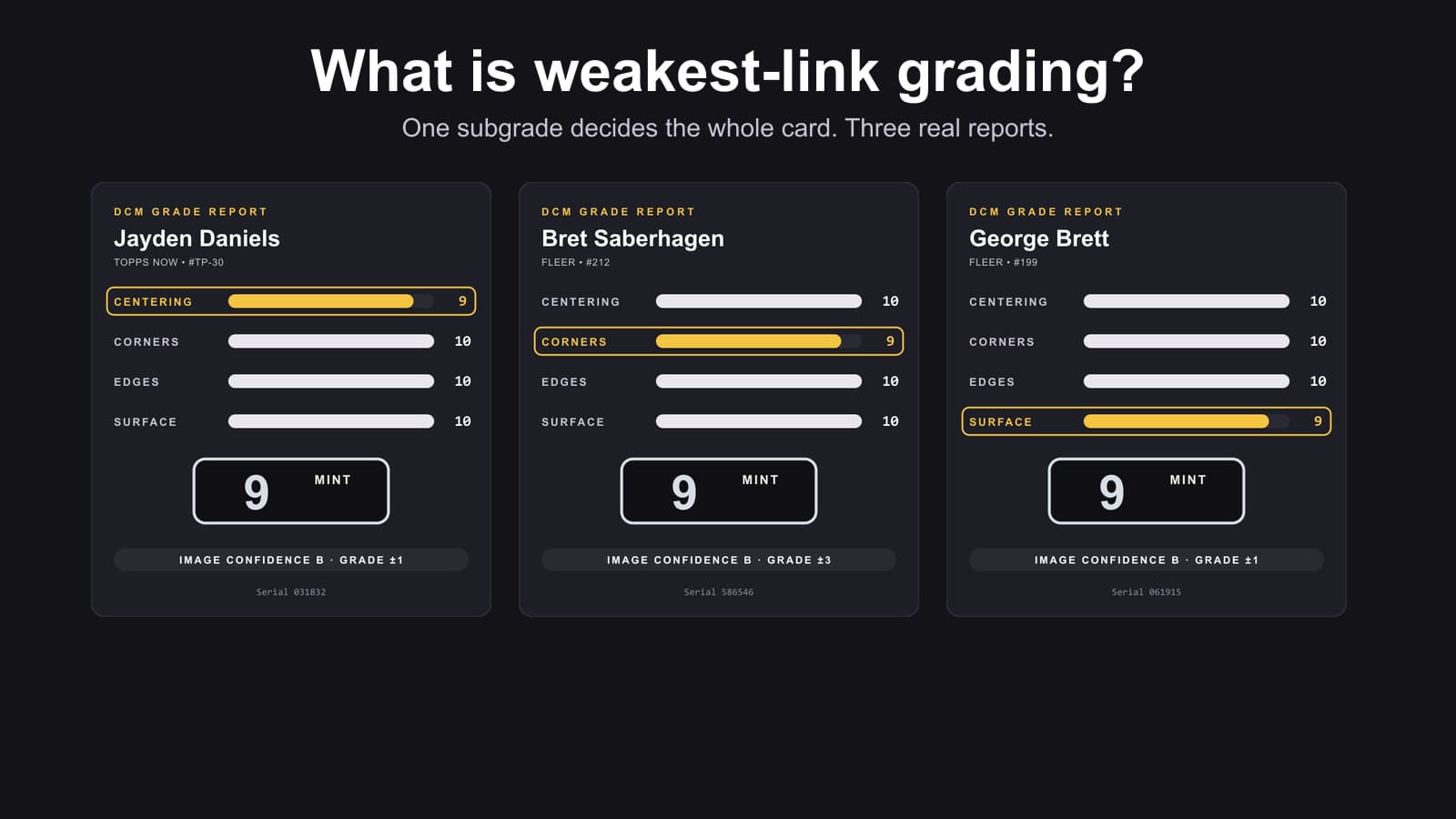
Three DCM grade reports side by side, each with three subgrades of 10 and one subgrade of 9 highlighted, each with a final grade of 9
Three real DCM reports where three factors scored a 10 and the card still came back a 9.
Quick answer
Weakest-link grading means the final grade equals the lowest of the four subgrades for centering, corners, edges and surface. A card with three 10s and one 9 is a 9. DCM grades this way because a buyer paying for Gem Mint expects the card to be Gem Mint in every respect, and the report names which factor set the grade.
Every DCM grade comes with four subgrades: centering, corners, edges and surface. The final grade is the lowest of the four. That is the entire rule, and it is called weakest-link grading.
It sounds simple. It also explains most of the grades collectors find surprising, so here it is on three real cards.
Three cards, three different weak links
 Three DCM grade reports: Jayden Daniels with centering 9, Bret Saberhagen with corners 9, George Brett with surface 9, all graded 9 Mint
Jayden Daniels, Topps Now. Corners 10, edges 10, surface 10, centering 9. Final grade: 9.
Bret Saberhagen, Fleer. Centering 10, edges 10, surface 10, corners 9. Final grade: 9.
George Brett, Fleer. Centering 10, corners 10, edges 10, surface 9. Final grade: 9.
Three cards that each scored 10 on three of four factors. Three 9s. In each case a different factor set the grade, and in each case the report names it.
Why not average them?
An average would give all three cards a 9.75, which rounds to a 10. That number would feel better and mean less.
A buyer paying Gem Mint money expects a Gem Mint card in every respect. If the corners are perfect but the centering is off, the card is not Gem Mint, and pricing it as one only works until the buyer looks closely. Weakest-link grading is how the hobby already prices cards. It just makes the rule explicit.
It also makes grades easier to trust. When the final number is defined by one factor, and the report tells you which one, there is nothing hidden in the math.
The other cap: structural damage
There is one exception to "lowest subgrade wins." A crease, a tear, paper loss or a surface that has been altered counts as structural damage, and it caps the grade no matter how the other factors score. A creased card with perfect centering is not an 8. The report says so when it applies.
How to use the subgrades
The subgrades are the most useful part of the report, more so than the final number, because they tell you what to do next.
- Centering 9, everything else 10. Nothing you do will change this card. It is a 9. Price it as one.
- Corners 9, everything else 10. Check whether the corner damage is real or a photo artifact, then check the image confidence letter. If the read was a B or C, better photos may change the result.
- Surface 9, everything else 10. Look at the card off-angle under a light. Surface is the factor most often invisible straight-on.
And if you are deciding which of a stack of cards to slab, sort by the weakest subgrade, not the final grade. Two 9s with different weak links are different cards to a buyer.
Reading it on your own cards
Every DCM report shows all four subgrades, the final grade, and the sentence that explains which factor set it. Photograph a card you already own and read the subgrades before the grade. You will learn more about the card from the lowest number than from the big one.
Frequently asked questions
- Why not average the four subgrades?
- An average of 10, 10, 10 and 9 rounds to a 10, which would price a card as Gem Mint when one factor is not. The lowest subgrade matches how buyers already judge cards.
- Is there any exception to the lowest-subgrade rule?
- Structural damage. A crease, tear, paper loss or altered surface caps the grade regardless of how the four subgrades score.
- How do I use the subgrades on my own cards?
- Look at which subgrade is lowest and read the reason in the report. That tells you what kept the card from the next grade and whether a better photo or a different card would change it.