The $25 Question: Which of These 40 Cards Deserve a Slab?
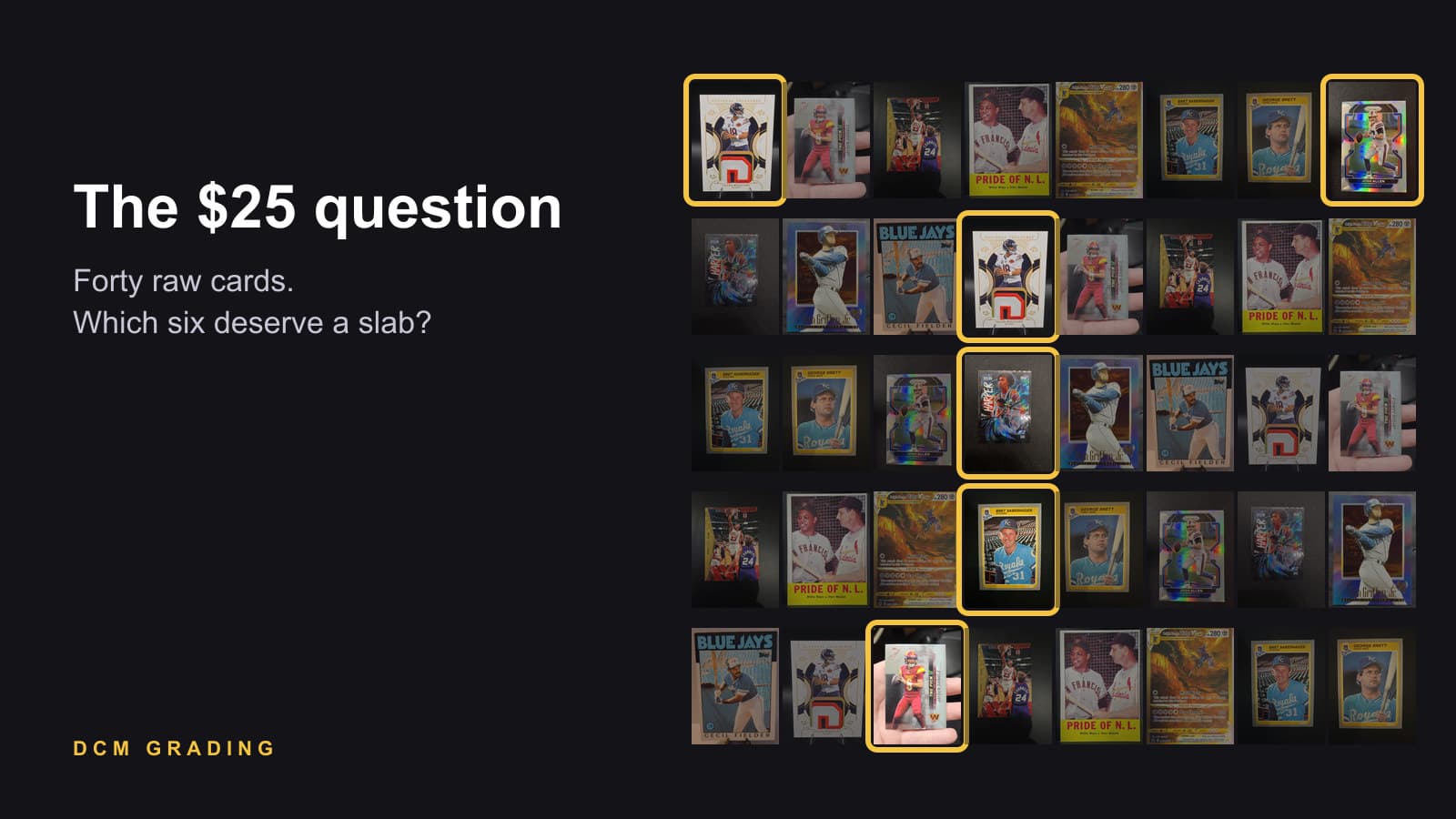
A grid of forty raw trading cards with six of them highlighted in gold
Forty raw cards, one afternoon, and the math on which six earned a holder.
Quick answer
Grade the whole stack at home first, then mail in only the cards that clear the bar. On a real stack of forty, the rule that held up was a final grade of 9 or 10 with no weak subgrade and a market value that covers the fee. Six of the forty qualified, which turned a $1,000 to $3,000 submission into a much smaller one.
Every collector has the stack. Forty cards, maybe more, pulled aside over a few months because they might be worth grading. The question is always the same: which of these deserve a $25 to $80 submission fee and a two month wait?
Here is that question answered on a real stack, with the math.
The math on grading all forty
Submitting all forty to a mail-away grader on a mid-tier service, at a conservative $25 per card, is $1,000 in fees before shipping and insurance. At the tiers that are actually open this summer, it is closer to $3,000. Either way, the cards are gone for weeks to months, and most of them will come back as 8s and 9s worth about what they were worth raw.
The problem is not that grading is expensive. It is that grading everything is expensive, and you do not know which cards are the good ones until after you have paid.
Grading all forty at home first
So grade all forty at home, then decide. Front photo, back photo, about a minute each. Forty cards took a little under an hour, including finding them.
What comes back for each card is the four subgrades and the final grade, plus the reason for any deduction. That is the sorting tool.
The sort
Here is the rule that fell out of the stack, and it is the one we would use again.
Slab it if all three of these are true:
- The final grade is a 9 or a 10
- The lowest subgrade is not centering (a centering 9 is permanent, while a corner 9 with a C confidence might improve on a retake)
- The card has a real market. A 10 on a card nobody is searching for is still a card nobody is searching for
Keep it raw, with the grade on file, if any of those is false. The grade still helps. It goes on the card page, it goes in your collection, and it goes in an eBay listing whether or not the card is in a holder.
Retake the photos if the confidence letter is a C or D, before deciding anything. Five of the forty came back with a C, and two of those moved after a retake.
What the stack looked like
| Result | Cards | What happened |
|---|---|---|
| 10 with a real market | 4 | Slabbed |
| 9 on corners or surface, market card | 2 | Slabbed |
| 9 on centering | 9 | Kept raw, grade on file |
| 8 | 14 | Kept raw, grade on file, two listed |
| 7 or below | 11 | Kept raw |
Six slabs out of forty. The other thirty-four are worth more raw with a grade on file than they would be in a holder with an 8 on it, and about $850 of fees stayed in my pocket.
The rule, in one sentence
Grade everything, slab the ones that earn it, and never pay a submission fee to find out a card is an 8.
Doing this with your own stack
Two free grades will get you started, and a pack of credits is priced so that grading a whole binder costs less than one express submission. The pop report post has the real 10 rates by category if you want to know the odds before you start, and the centering post explains why that one subgrade is the permanent one.
Best ValueVIP$99150 credits · $0.66/gradeLowest one-time pack rateBasic$2.991 credit · $2.99/grade+1 bonus on first purchasePro$9.995 credits · $2.00/grade+3 bonus on first purchaseElite$19.9920 credits · $1.00/grade+5 bonus on first purchaseSee all credit packsCredits never expire. New accounts start with two free grades.Frequently asked questions
- How much does it cost to grade 40 cards with a mail-away service?
- At a conservative $25 per card it is about $1,000 in fees before shipping and insurance. At the tiers that were actually open in summer 2026, closer to $3,000, and the cards are gone for weeks to months.
- What rule decides whether a card deserves a slab?
- All three must be true: the final grade is a 9 or 10, the lowest subgrade is not dragging the card down, and the price difference between raw and graded copies covers the submission fee with room to spare.
- How long does it take to grade a stack of 40 cards at home?
- A little under an hour, including finding the cards. Each card is a front photo and a back photo, and the grade with four subgrades comes back in about a minute.
- What happens to the cards that do not qualify?
- They stay raw and stay in the collection. The grade and the written reasons for any deduction still go on record, so you know exactly why each one did not make the cut.