Card Centering Explained: What 55/45 Means, Where the Cutoffs Sit, and Why It Caps the Whole Card
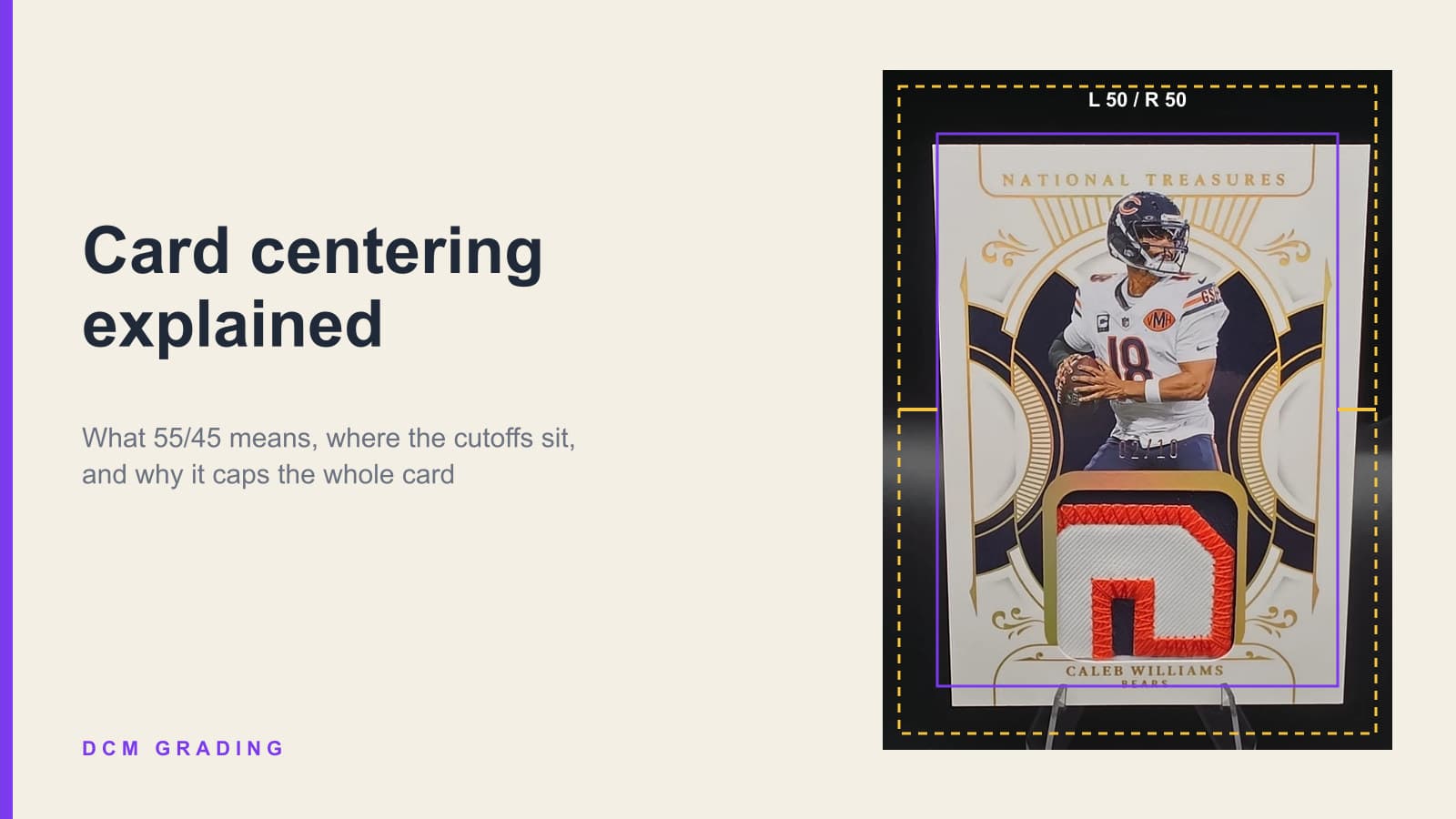
A Caleb Williams National Treasures patch card with centering guide lines overlaid, labelled L 50 R 50
The one measurement most collectors cannot make by eye, shown on real graded cards.
Quick answer
Centering is the ratio of the left border to the right border and the top border to the bottom, written as two numbers like 55/45. A card is judged by its worse axis, and most Gem Mint standards cut off around 55/45 on the front, so a card that looks perfect at arm's length can still miss a 10. DCM treats centering as a subgrade that can cap the whole card.
Centering is the grading factor collectors argue about most, and the one they can judge least reliably by eye. A card can have four sharp corners, clean edges and a flawless surface and still come back a 9, or an 8, because the picture sits a little to the left of where the printer meant to put it.
So here is what the ratio means, what the common cutoffs look like on real cards, and why DCM treats centering as a subgrade that can cap the whole card.
What the numbers mean
Centering is expressed as two ratios: left/right and top/bottom. Take the width of the left border and the right border, add them together, and express each as a share of the total. A card with a 3 mm left border and a 3 mm right border is 50/50. A card with a 3.3 mm left border and a 2.7 mm right border is 55/45.
The same calculation runs top to bottom. A card is usually described by its worse axis, so "60/40" means one pair of borders is split 60 to 40, even if the other pair is nearly perfect.
 Four schematic cards showing 50/50, 55/45, 60/40 and 70/30 centering, with the picture window shifting further off centre in each
The thing to notice is how small the differences are. At 55/45, one border is 22 percent wider than the other. On a modern card with 2.5 mm borders that's roughly half a millimetre. Nobody sees half a millimetre at arm's length, which is exactly why a card that looks perfect in hand can miss a Gem Mint cutoff.
Where the cutoffs sit
Every grading company publishes its own standard, and they differ, but the shape is similar across the hobby. As a rough guide for the front of a modern card:
| Grade | Front centering typically allowed |
|---|---|
| Gem Mint 10 | about 55/45 or better |
| Mint 9 | about 60/40 or better |
| Near Mint-Mint 8 | about 65/35 or better |
| Near Mint 7 | about 70/30 or better |
The back is usually allowed to be worse than the front at each grade. Vintage cards are often held to a slightly looser standard because the printing was less consistent. Check the standard of whoever you're submitting to, because a card that is a 10 by one rulebook can be a 9 by another.
Real cards, real centering subgrades
Here are four cards graded on DCM, one at each centering subgrade from 10 down to 7. Look at the borders, not the picture.
 Four graded cards in a row: a Caleb Williams National Treasures at centering 10, a Jayden Daniels Topps Now at centering 9, a Michael Jordan Upper Deck SP at centering 8, and a Willie Mays and Stan Musial Topps card at centering 7
- Centering 10, final grade 10. Caleb Williams, National Treasures. Borders match on every side.
- Centering 9, final grade 9. Jayden Daniels, Topps Now. Corners, edges and surface all graded 10. The centering subgrade is the entire reason this card is a 9 and not a 10.
- Centering 8, final grade 8. Michael Jordan, Upper Deck SP. The report reads: "The grade comes down to centering, the borders are visibly uneven. The corners, edges and surface are otherwise excellent."
- Centering 7, final grade 7. Willie Mays and Stan Musial, Topps. Once you know to look, the shift is obvious.
Why centering caps the whole card
DCM grades on a weakest-link basis. Each of the four subgrades is scored on its own, and the final grade is the lowest of the four. A card that is 10, 10, 10 on corners, edges and surface with a 9 on centering is a 9.
That can feel harsh on a card that's otherwise perfect, but it's how the hobby prices cards. A buyer paying for a Gem Mint card expects it to be Gem Mint in every respect. The subgrades exist so you can see exactly which factor set the grade, and centering is by far the most common one.
How to check centering yourself
You don't need a tool, but a tool helps. A clear ruler with millimetre marks, or the phone camera at a straight-down angle, is enough to compare opposite borders. Measure at the middle of each edge, not the corners, because rounded corners distort the reading.
If the two borders on one axis differ by more than about 20 percent, the card is outside the usual Gem Mint range no matter how clean it is. That's worth knowing before you spend a submission fee.
Or photograph it and let DCM Optic measure it. Every DCM report carries a centering subgrade alongside corners, edges and surface, so you know which factor is doing the work before you decide whether the card deserves a slab.
Frequently asked questions
- What does 55/45 centering mean?
- One border takes 55 percent of the combined border width and the opposite border takes 45 percent. On a modern card with 2.5 mm borders that is roughly half a millimetre of difference, which is why it is hard to see by eye.
- Is centering measured on the front or the back?
- Both. Graders typically allow a looser ratio on the back than the front, and the card is described by its worse axis on each side.
- Can bad centering lower a card with perfect corners, edges and surface?
- Yes. Under a weakest-link rule the final grade cannot exceed the lowest subgrade, so a centering subgrade of 8 caps an otherwise flawless card at 8.
- How do I check centering myself?
- Measure each border with a ruler or a centering tool, add the opposite pair together and express each as a share of the total. Or photograph the card and let DCM measure both axes on both sides.