Found Your Old Trading Cards? Sort a Childhood Collection Before Selling or Grading
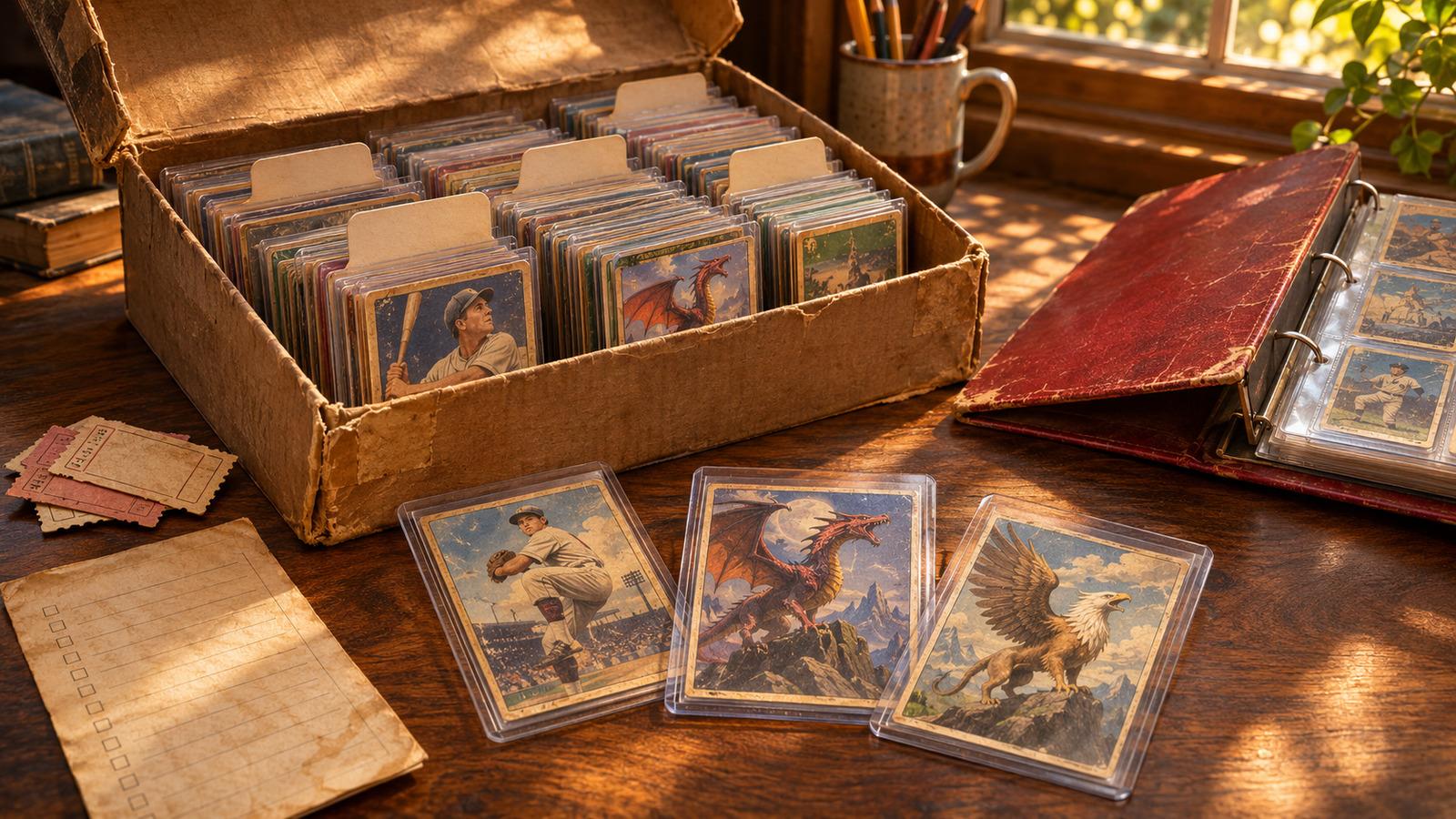
AI-created editorial illustration of a nostalgic shoebox collection with sleeved fictional sports and fantasy cards and an old binder.
A first-pass plan for the shoebox, binder or inherited collection: preserve it, identify it, and research the right cards first.
Quick answer
Photograph the collection as found, handle it carefully, and separate cards by game or sport, set and era. Pull out cards that need protection or identification, then research exact versions using completed sales. Do not clean, force apart stuck cards, sell an unfamiliar lot or pay to grade everything before understanding what is there.
An old binder is part collection and part time capsule. It may contain a valuable printing, a well-loved favorite or hundreds of cards whose main value is the memory attached to them. You do not need to decide which is which in the first ten minutes.
Your first job is to preserve the information already there: how the cards were grouped, what the labels say and which items need careful handling.
A first session you can actually finish
Try the short plan below before opening a marketplace tab. The suggested time boxes keep the task manageable; they are permission to stop, not a reason to rush a fragile card.
 Suggested 20-minute first session: photograph for five minutes, separate categories for five, record identities for five, and label containers for five. Adjust or stop for fragile items.
Field note 1: preserve the context
Take pictures of the boxes, binder covers, divider labels and any notes. Keep purchase receipts, packaging and provenance with the collection. They may help identify an item or document its history, even though they do not independently prove authenticity.
Work in a clean, dry space. If cards are stuck together, damp, flaking or adhered to old pages, do not pull them apart. Set them aside for appropriate specialist advice. The same applies to a valuable-looking card trapped in a damaged holder.
Field note 2: make five sorting groups
 Five sorting destinations for an old collection: personal keepsakes, identify next, inspect or protect, ordinary set cards, and specialist review. Sorting categories are suggested, not market-value claims.
| Group | What goes here | Next action |
|---|---|---|
| Personal keepsakes | Cards you would keep regardless of price | Protect and record |
| Identify next | Unfamiliar sets, variants, promos or stamps | Match exact references |
| Inspect or protect | Cards with wear, loose storage or fragile surfaces | Photograph; choose compatible protection |
| Ordinary set cards | Identified cards without an immediate research priority | Keep in organized groups |
| Specialist review | Suspected alterations, authenticity issues or fragile items | Seek relevant expertise |
These categories can overlap. A sentimental card can also need specialist attention. The point is to avoid treating the whole box as either treasure or junk.
 Four-way sorting matrix combines known or unknown identity with stable or fragile condition, directing the next step toward research, identification or specialist handling advice.
An unknown card in stable condition and an unknown card stuck to a page need different next steps. Use identity and handling condition as separate questions; neither is a shortcut to market value.
Field note 3: identify before pricing
For sports cards, record the full product name, year, player and card number. Check the back. Similar photographs can appear on different issues, and a copyright date is not always enough to identify a release.
For Pokémon, record the name, language, set symbol or code, number and finish. Our card anatomy guide shows where to look. Do not assume age, a familiar character or a shiny surface identifies the scarce version.
Write down uncertainty. A card described as “possibly a first edition” still needs the printing confirmed. Reprints and commemorative releases can resemble older designs. A reliable checklist or specialist can be more useful than the highest listing returned by an image search.
Look at condition without trying to improve it
Check corners, edges, centering and surface on both faces. Use soft light and an angled view for reflective cards. A card can look impressive in a binder while its reverse shows whitening, scratches or a crease.
 DCM macro photographs show the kinds of corner, edge and surface details to inspect when sorting an older collection. The examples do not establish the value of another card.
Do not rub stains, recolor edges or press folds before an assessment. Original condition matters, and treatments can complicate grading. Our guide to why cards miss a 10 is useful even if your collection is nowhere near Mint: it teaches you where to look.
Research a manageable shortlist
Pick a small group of clearly identified cards. Compare completed sales of the same version and similar condition. Exclude lots, different languages, different parallels and slabs from other grading categories unless you explicitly account for those differences.
The sports-card valuation guide walks through the process. Keep the date and source of each comparison. A single ambitious asking price does not establish what your copy can sell for.
For an unfamiliar collection that appears significant, consider more than one informed opinion before accepting a whole-lot offer. Separate any sentimental cards before negotiating so you do not make a rushed decision about something you intended to keep.
Which cards should you grade?
Grade with a purpose: documenting a favorite, improving a condition record, or considering a physical grading submission. Fees, shipping, selling costs and uncertainty belong in the decision. Age alone does not make grading worthwhile, and a low grade does not make a card meaningless.
DCM can help document visible condition from good photos. It does not authenticate an old card or guarantee the grade another company will assign. If identity, authenticity or alteration is the main uncertainty, address that first. Read is grading cards worth it before committing an entire collection.
Leave a trail for the next session
Label the containers, keep a short inventory and save photographs of the cards you researched. Record which cards are personal keepsakes and which remain unconfirmed. You can stop after one useful sorting session; the rest of the collection will be easier to work through because you preserved its order and documented what you learned.
Header artwork is an AI-created editorial illustration. Its fictional cards and scenes are not product references, condition-test results or authentication evidence.
Frequently asked questions
- Should I grade every card in an old collection?
- No. Identify the cards and assess your goal first. Grading fees and effort should be weighed against the usefulness of the record, sentimental value or a realistic selling plan.
- Are old baseball cards always valuable?
- No. Age is one factor. Exact issue, demand, scarcity and condition matter, and some older cards were produced in very large quantities.
- What should I do with cards stuck together?
- Do not force them apart or add liquid. Set them aside and seek appropriate specialist advice, especially if they may be valuable or fragile.
- Should I sell a childhood collection as one lot?
- A lot sale may be convenient, but understand the important cards and remove keepsakes first. Compare the convenience of a lot offer with the work and uncertainty of individual sales.