How to Read a Pokémon Card: Set Symbol, Number, Rarity and Every Other Mark
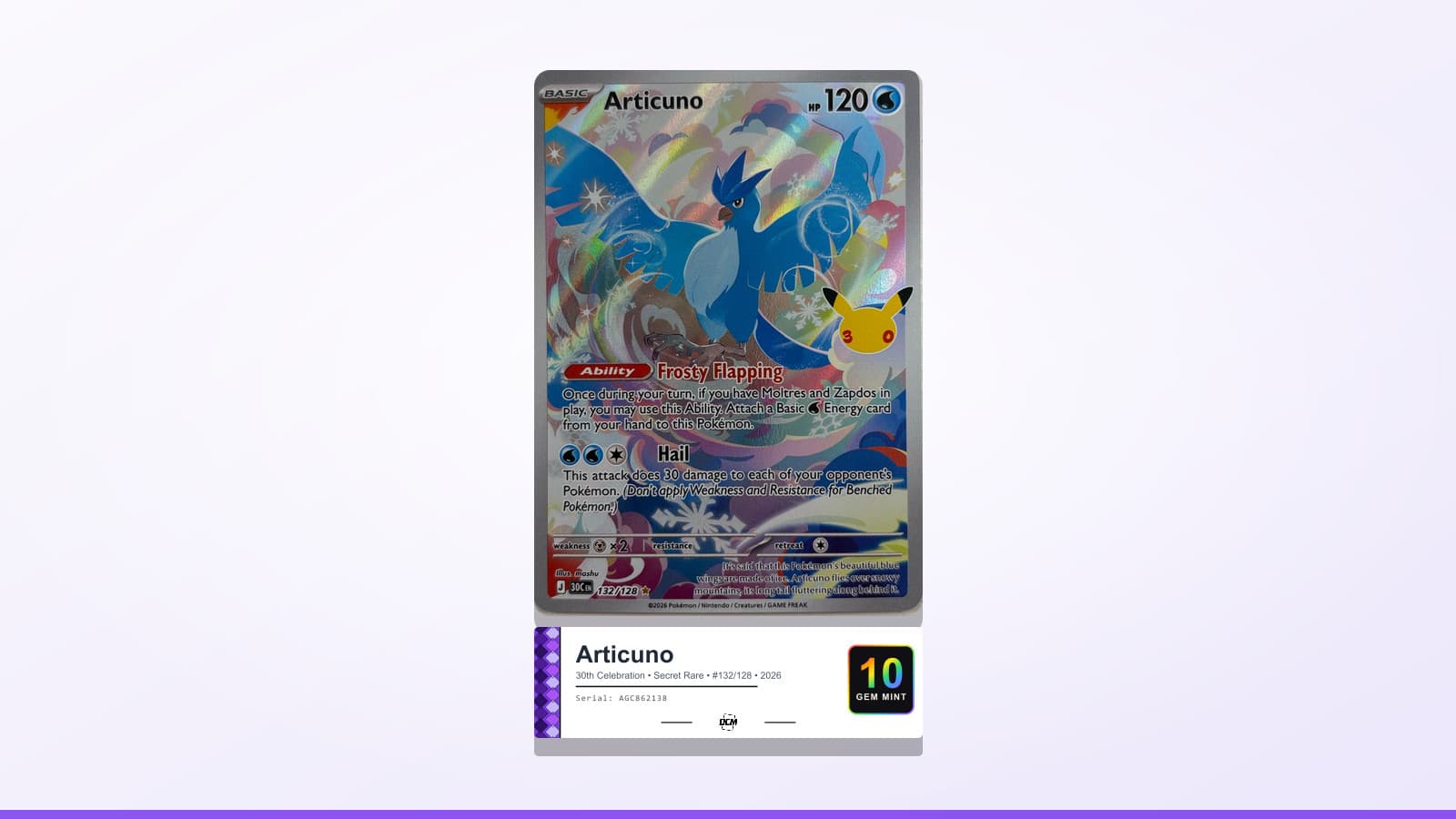
Articuno 132/128 from 30th Celebration graded DCM 10, with its Heritage label
The ten parts of a modern Pokémon card, what the four marks in the bottom corner mean, and how to use them to identify and price any card.
Quick answer
To read a Pokémon card, look at the bottom-left corner: the regulation mark (a letter in a box), the set code (such as 30C EN), the card number (such as 132/128) and the rarity symbol (circle, diamond, star, or gold and silver stars). A number higher than the set size means a secret rare. The name and stage sit at the top, HP and type at top right, attacks in the middle, and weakness, resistance and retreat cost along the bottom. The set code and card number together identify the exact card.
A Pokémon card tells you exactly what it is, if you know where to look. The name is obvious. The parts that identify the card, and decide what it is worth, are small, printed in the bottom corner, and easy to overlook.
Here is a real card, an Articuno from the 30th Celebration set that graded a DCM 10, with every part labelled.
 Annotated Articuno card with ten numbered callouts: stage, name, HP, attacks, battle stats, illustrator, regulation mark, set code, card number and rarity symbol
The ten parts of a card
- Stage. Basic, Stage 1, Stage 2, or a mechanic such as ex, V or Mega. Top left.
- Name. The Pokémon, plus any suffix. "Mega Darkrai ex" and "Darkrai" are different cards.
- HP and type. Hit points and the energy type symbol, top right.
- Ability and attacks. Cost, name and effect. These matter for play and almost never for grading or price.
- Weakness, resistance and retreat cost. The bar along the bottom.
- Illustrator. "Illus." and the artist's name. Searchable on its own, and some artists carry a premium.
- Regulation mark. A letter in a box, bottom left. It governs tournament legality and is a quick check on the card's era: J appears on 2026 cards.
- Set code. The printed abbreviation for the set. Here, 30C EN: 30th Celebration, English print.
- Card number. Printed as number over set size: 132/128.
- Rarity symbol. A circle, diamond or star for common, uncommon and rare, and gold or silver stars for the higher tiers.
The four marks that matter most
 Close-up of the bottom-left corner of a Pokemon card showing the regulation mark J, set code 30C EN, number 132/128 and a gold rarity star
The bottom-left corner holds everything a database, a buyer or a grader needs. Read it left to right:
- Regulation mark J: a card from the current era.
- Set code 30C EN: the set and the language. Older cards use a set symbol (a small picture) instead of a code; cards from 2023 on carry both.
- Number 132/128: card 132 in a set whose main run is 128 cards. Any number above the set size is a secret rare, which is why this Articuno is worth grading.
- Gold star: the rarity tier. Combined with the number, it tells you this is an Illustration Rare, not a reprint of the regular Articuno.
Type the set code and number into the Pokémon database and you have the exact card, its set and its market price. When DCM grades a card, this is the same corner DCM Optic reads to identify it, and the report lists the set, number and year it found.
The rarity ladder
 Pokemon TCG rarity ladder from Common up to Mega Hyper Rare with the symbol for each tier
| Symbol | Rarity | What it means |
|---|---|---|
| Circle / diamond / star | Common, Uncommon, Rare | The bulk of every set |
| Two black stars | Double Rare (ex) | Playable ex Pokémon with standard art |
| Two silver stars | Ultra Rare | Full-art ex and Trainer cards |
| One gold star | Illustration Rare | Alternate art, often the collector favourite |
| Two gold stars | Special Illustration Rare | Full-bleed art; the main chase in most sets |
| Three gold stars | Hyper Rare / Mega Hyper Rare | Gold-foil cards, the rarest pull |
Rarity drives price far more than grade does for most modern cards. A Common in a 10 is worth less than an Illustration Rare in an 8. Decide what a card is before you decide whether to grade it.
Older cards: set symbols and first editions
Cards from before 2023 have a small set symbol next to the number instead of a code, and the oldest sets have none at all. Base Set cards with no symbol, a shadowless border or a "1st Edition" stamp are separate, more valuable printings of the same card, and the differences are a few millimetres. The Pokémon grading guide covers how to photograph those details so they show on the report.
Putting it together
Reading a card is three steps: find the set code and number, check the rarity symbol, and look the card up. From there, a DCM grade gives you the condition and a price estimate in about a minute, and a report page anyone can verify. Pokémon grading has the details.
Pokémon and card names are trademarks of their owners. DCM is not affiliated with The Pokémon Company.
Frequently asked questions
- Where is the set symbol on a Pokémon card?
- In the bottom-left corner on modern cards, printed as a set code such as 30C EN next to the regulation mark and the card number. Cards printed before 2023 use a small picture symbol in the same area, and the oldest sets have no symbol at all.
- What does 132/128 mean on a Pokémon card?
- Card 132 in a set whose main run is 128 cards. Any card numbered above the set size is a secret rare, such as an Illustration Rare, Special Illustration Rare or Hyper Rare.
- How do I tell a Pokémon card's rarity?
- By the symbol next to the card number: a circle is common, a diamond uncommon and a black star rare. Two black stars mark a Double Rare, two silver stars an Ultra Rare, one gold star an Illustration Rare, two gold stars a Special Illustration Rare and three gold stars a Hyper Rare.
- What is the letter in a box on a Pokémon card?
- The regulation mark. It shows which tournament format the card is legal in and is a quick guide to the card's era. Cards printed in 2026 carry the letter J.