How to Value Sports Cards: What Determines a Card's Worth
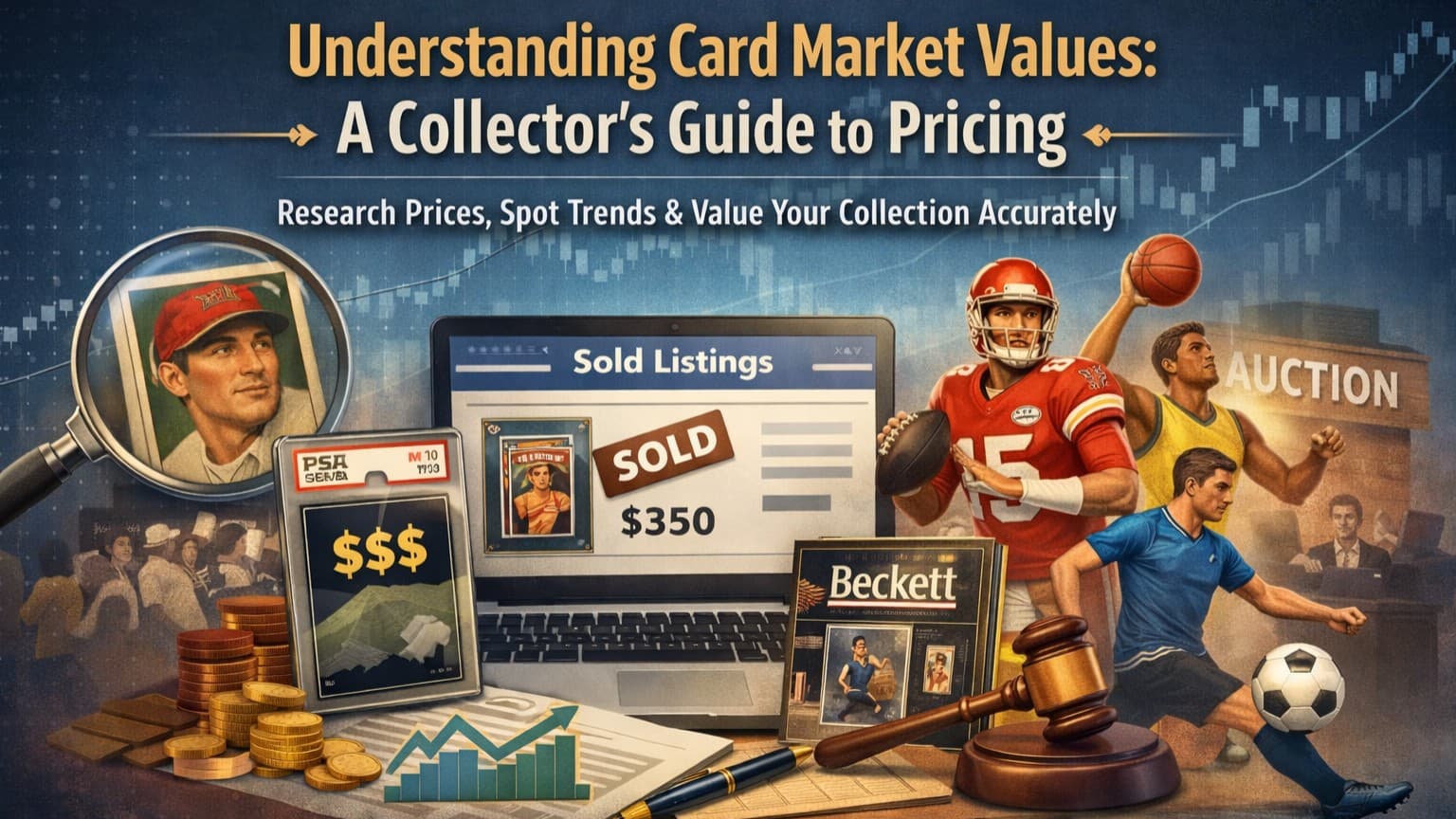
Guide to valuing sports cards: condition, demand, scarcity, significance and market sentiment
The five factors that set a card's price, how to research sold prices, what eBay really takes, and how to value a collection in one place.
Quick answer
A card's value is what buyers recently paid for the same card in the same condition. Condition, player or character demand, scarcity, historical significance and market sentiment set that price. To value a card, identify the exact card, know its condition, use the median of recent sold prices (never asking prices) and subtract selling fees.
What Determines a Card's Value?
"What's my card worth?" is the most common question in collecting. The short answer: a card is worth what buyers have recently paid for the same card in the same condition. Five things move that number:
- Condition (grade). The biggest single factor for most cards. The same card can sell for multiples of itself between a mid grade and a gem mint copy.
- Player or character demand. Performance, awards, rookie status, and for trading card games, how popular the character is.
- Scarcity. Print runs, numbered parallels, short prints and one-of-ones.
- Historical significance. Rookie cards of all-time greats, iconic sets, documented error cards.
- Market sentiment. The economy, media attention, nostalgia cycles and how many new collectors are entering the hobby.
Here is how to turn those factors into a price you can defend, plus how to do the whole job in one place.
How to Find Out What Your Card Is Worth
Step 1: Identify the exact card
Year, brand, set, card number and parallel. A base card and its numbered refractor can be hundreds of dollars apart, so "2018 Prizm Luka Doncic" isn't specific enough. Get every detail right before you look at a single price.
Step 2: Know the condition
You can't price a card until you know its condition, because sales are split by grade. A raw card is not worth graded prices, and a card with a soft corner is not worth what a sharp copy sold for. Be honest here. This is the step most collectors skip.
Step 3: Look at sold prices, not asking prices
A listing at $500 tells you what someone hopes. A sale at $180 tells you what happened. To research it by hand:
- Search eBay for the exact card
- Filter by Sold Items
- Look at the last 30 to 90 days of sales
- Throw out the outliers, high and low
- Take the median for your card's condition
Step 4: Subtract the cost of selling
The price a card sells for isn't the money you keep (see the fee breakdown below).
Where to Research Card Prices
eBay sold listings
The largest pool of real transactions for most cards. Sold listings, filtered to the exact card and condition, remain the best place to start.
Price guides and sales databases
- PriceCharting and SportsCardsPro: raw and graded sold-price data across sports and trading card games
- PSA Price Guide: average prices realized for PSA-graded cards
- Card Ladder: sales history and market indexes
- 130 Point: searches eBay sales, including best-offer prices
One caveat: guide prices can lag a fast-moving market. For a player who just broke out, check the most recent individual sales.
Auction houses
For high-end cards, look at recent results from Heritage Auctions, Goldin, Fanatics Collect (formerly PWCC) and Lelands. These set the market for premium cards, but they don't reflect typical collector sales.
The Value Factors in Detail
 Factors That Influence Sports Card Value
1. Condition
Condition is graded on corners, edges, surface and centering, and the weakest of the four usually decides the grade. That is why one soft corner can cost a card more value than you'd expect. (More on that in what weakest-link grading means.)
The gap between grades is not a fixed percentage. It depends on the card. For a common base card, raw and graded prices sit close together. For a key rookie or chase card, a top grade can sell for many times a mid-grade copy. The only way to know for your card is to look at its sold prices grade by grade.
2. Player and character demand
Nothing moves sports card prices like what happens on the field:
- Rookie seasons: breakout performances spike prices
- Championships and awards: titles and MVPs create demand surges
- Injuries: can suppress values temporarily, or permanently
- Retirement: often stabilizes prices
- Hall of Fame induction: can bring renewed interest to a player's key cards
Trading card games follow the same logic with characters instead of players. A popular Pokémon or a tournament-staple Magic card holds demand that a filler card never will.
3. Scarcity and print runs
- Base cards: highest print runs, lowest values
- Parallels: numbered cards command premiums. "/99" means 99 copies exist
- Short prints: intentionally limited production
- 1/1s: unique cards, priced by whoever wants it most
4. Historical significance
Some cards sit outside normal valuation: rookie cards of all-time greats, landmark sets like 1952 Topps, documented error cards, and cards tied to iconic moments.
5. Market sentiment
The whole market rises and falls together. Recessions suppress spending on collectibles, documentaries and news coverage drive interest, collectors buy back their childhood as they age, and waves of new collectors (like 2020 to 2021) lift prices across the board.
Common Pricing Mistakes
- Using asking prices. A listing means nothing until it sells.
- Ignoring condition. Your raw card is not worth top-grade prices.
- Overvaluing commons. Most cards, even of great players, sell for a few dollars.
- Cherry-picking comps. One high sale isn't the value. Use the median of several.
- Forgetting fees. The sale price isn't what lands in your account.
What Selling Actually Costs on eBay
For trading cards, eBay charges a final value fee of 13.25% on the total amount of the sale up to $7,500, plus $0.40 per order ($0.30 on orders of $10 or less). The total includes the shipping the buyer pays and sales tax, not just the card price.
A worked example: a card sells for $100, the buyer pays $5 shipping, and sales tax is collected on top. The fee comes to roughly $14 to $15. After you pay the postage, you keep about $85.
Fees from eBay's selling fees page, checked October 2026. eBay updates them periodically, so check the current rates before you price a high-value card.
How to Value Your Cards in One Place with DCM
Everything above works, but it's slow. Do it for one card and it takes ten minutes. Do it for a binder and it takes a weekend. DCM handles the whole process, from condition to price to sale, in one place:
- Grade it. Photograph the front and back. In about a minute, DCM Optic™ returns four subgrades (centering, corners, edges, surface) with a written reason for every deduction, plus an image confidence letter from A to D and an uncertainty range, so you know how firm the grade is.
- See what it's worth. DCM shows raw and graded sold-price estimates side by side, built from real sold listings in collaboration with PriceCharting Pro and SportsCardsPro. That covers steps 3 and 4 of the manual process, without the spreadsheet.
- Track it. Every graded card goes into your collection and Portfolio, where you can see total value, value by grade, and how each card's value has changed since you graded it.
- Slab it. Print a DCM label for a graded slab, magnetic one-touch or toploader. Every label carries a QR code that opens a public verification page with the grade, subgrades and reasoning, so a buyer can check it for themselves.
- Sell it. InstaList builds the eBay listing for you: card images, label front and back, the mini grade report, and a title and description written for you. You don't even have to slab it.
 Instantly List Sports Cards to eBay with DCM
Most of a collection ends here: graded, valued, slabbed and listed without ever leaving your hands. For the small top slice of genuinely high-value cards, the price data shows you what those cards trade for at each grade, so you can decide what fits your goals.
Price Trends to Watch
- Modern rookies are volatile. Prices can swing hard on a few weeks of performance, so price them off the most recent sales.
- Women's sports cards have drawn growing collector interest as leagues and stars gain audiences.
- Soccer and international cards keep gaining ground with US collectors.
- Trading card games like Pokémon and One Piece now sit alongside sports as major segments of the hobby.
Treat any trend as a reason to check recent sales, not as a forecast.
The Bottom Line
Card values aren't fixed. They move with condition, demand, scarcity and the market. The collectors who price well:
- Identify the exact card before looking at prices
- Know the condition honestly
- Use sold prices, never asking prices
- Account for fees before they list
- Track their collection over time instead of guessing
Know what your collection is worth. Grade your first two cards free with DCM and see condition, raw and graded prices, and a listing-ready report in one place.
Frequently asked questions
- What factors determine a card's overall value?
- Five factors: condition (grade), demand for the player or character, scarcity and print run, historical significance, and overall market sentiment. Condition is usually the biggest, because sales are split by grade and the gap between grades can be large for key cards.
- How do I find out what my card is worth?
- Identify the exact card (year, set, number, parallel), determine its condition, then look at recent sold prices for that card in that condition and take the median. DCM does this in one place: it grades the card from photos and shows raw and graded sold-price estimates from PriceCharting Pro and SportsCardsPro.
- What is the most reliable source for card prices?
- Recent sold prices for the exact card and condition. eBay sold listings are the largest pool of real sales; PriceCharting, SportsCardsPro and 130 Point organize that sales data. Asking prices only show what sellers hope to get.
- How much does a card's grade change its value?
- It depends on the card. For common base cards, raw and graded prices are close. For key rookies and chase cards, a top grade can sell for many times a mid-grade copy. Check the sold prices for your specific card at each grade.
- How much does eBay take when I sell a card?
- For trading cards, 13.25% of the total sale (including shipping and sales tax) up to $7,500, plus $0.40 per order ($0.30 on orders of $10 or less). On a $100 card you keep roughly $85 after fees and postage.
- What pricing mistakes do collectors make most?
- Using asking prices, ignoring condition, overvaluing common cards, cherry-picking the highest sale and forgetting seller fees.