Sports Card Parallels, Refractors, Inserts and Short Prints: Identify What You Have
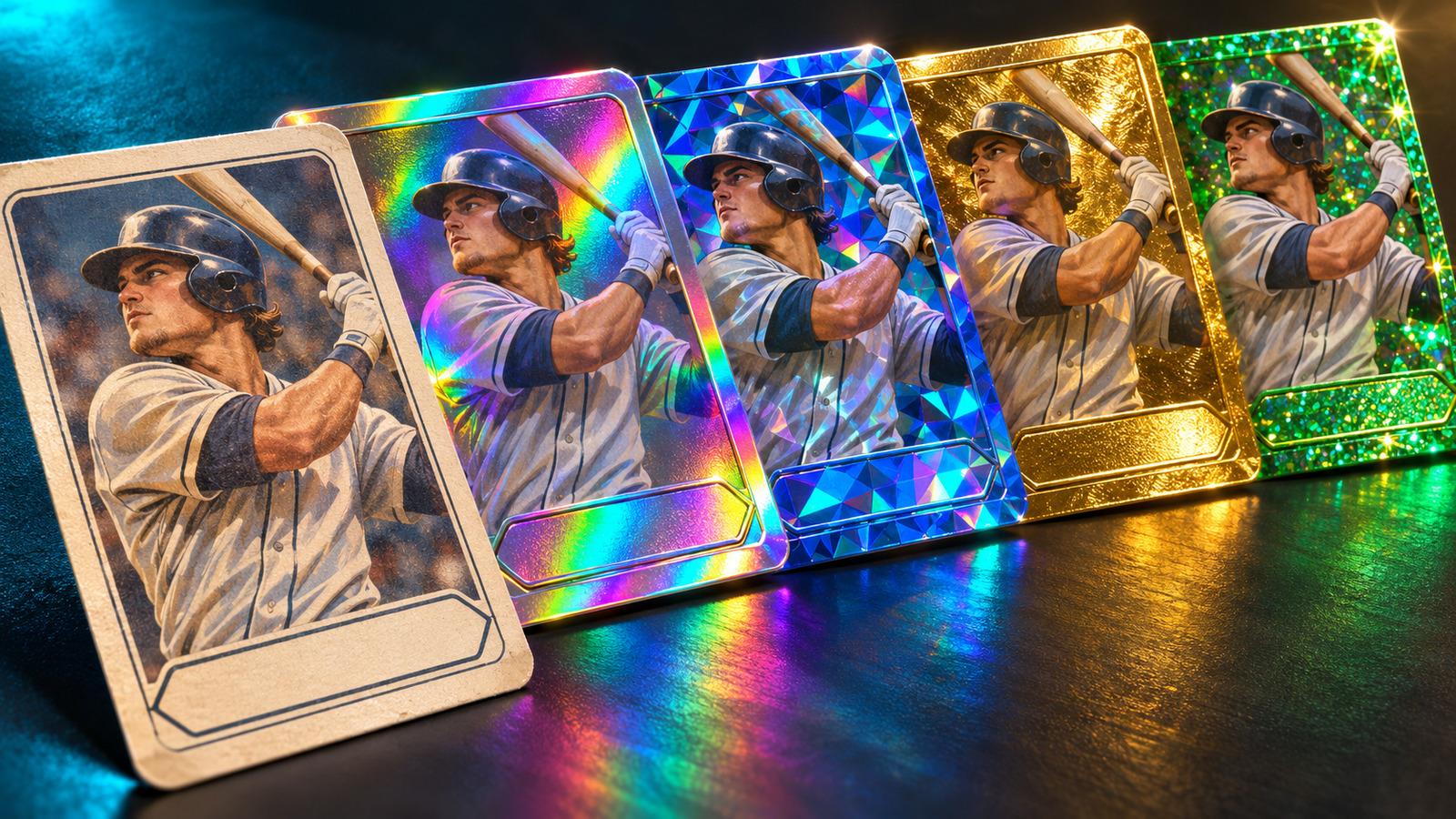
AI-created conceptual illustration of fictional baseball cards with paper, chrome, blue, gold and green finishes; not a real product checklist.
The name on the front is only the start. Read the set, card number, finish and checklist before you look up a price.
Quick answer
A parallel is a variation of a card within a set, often distinguished by color, finish or numbering. An insert belongs to a separate themed subset, and a short print has a smaller production quantity than the comparison group. A Refractor is a Topps reflective treatment. Identify the exact release and checklist entry before pricing any version.
Two cards can show the same athlete, carry the same card number and sell in very different markets. The missing information is often a parallel name, finish or image variation.
The first job is identification. A price search made before that job is finished can be confidently wrong.
Start with a serial number: what does 17/99 mean?
 Fictional sports-card identity specimen: product, player, card number, Blue parallel and serial 17/99. All names and product details are illustrative.
On a legitimately manufacturer-numbered card, 17/99 identifies that copy as number 17 in a numbered edition of 99. It does not mean there are only 99 cards of that athlete or only 99 cards with that photograph. Other parallels, languages, inserts and releases may exist.
Consider a hypothetical checklist with a base card, a Blue /99 parallel and a Gold /50 parallel. A sale of Gold /50 is not a direct comparable for Blue /99. The example illustrates identification, not a real checklist or a price prediction. A lower serial limit alone does not establish which card collectors will pay more for.
 Bar chart comparing the hypothetical Blue /99 and Gold /50 editions: 99 versus 50 numbered copies. These are invented checklist examples, not actual print runs or prices.
The chart answers one narrow question: how many copies are in each hypothetical numbered edition. It cannot tell you demand, authenticity, condition or price. Those need their own evidence.
Collectors sometimes seek jersey-number copies or the first or last serial number. Treat any claimed premium as something to test against completed sales, not an automatic multiplier.
How to identify a sports card in five checks
- Read the year and full product name. A flagship paper release and its Chrome counterpart are different products. A copyright line is a clue, not always the complete release name.
- Find the card number. Check the reverse as well as the front. An insert prefix may identify a separate checklist.
- Inspect the finish and design. Compare the border, pattern and photograph with a known reference from the same release. Rotate reflective cards under diffuse light.
- Record every stamp. Include serial numbering, promotional marks and special logos. Photograph the stamp clearly.
- Match the official checklist. Confirm that the exact combination exists. If the manufacturer provides image-variation codes, use the guide for that particular release.
 Identification workflow: full product name, card number, finish or image, serial stamp, then official checklist. Compare sold prices only after those checks.
Do not use a suffix from an online guide for another year. Manufacturers can change numbering systems, back codes and parallel names. When you cannot confirm the finish from a photo, leave it unconfirmed rather than selecting the most valuable possibility.
Keep this glossary beside the checklist
| Term | What it describes | What it does not prove |
|---|---|---|
| Base card | A regular card in the main checklist | That every copy has identical condition |
| Parallel | A variation of a base or insert card | A fixed print run unless one is documented |
| Refractor | A Topps reflective card treatment | That every shiny card is a Refractor |
| Insert | A card in a separate themed subset | That it is always rarer than every base parallel |
| Short print / SP | Lower production relative to the relevant group | A universal quantity across products |
| Super short print / SSP | A still scarcer designation within a product | A standard industry-wide numerical cutoff |
| Serial-numbered | An individually numbered edition | A guaranteed resale value |
Topps’ collector glossary is a useful starting point for the manufacturer’s terminology. Product checklists are the next step because names and treatments vary across releases.
Is an insert also a parallel?
It can have parallels. An insert is the card’s checklist family; a parallel is a version within that family. That means the complete name may need both an insert title and a color or finish.
The cover uses fictional cards to illustrate different finishes. For an actual purchase, compare versions from one verified checklist and inspect photographs of the copies being sold. The existing DCM display example below shows why the product, insert name and card number belong beside the player’s name in your record.
 Existing DCM Aaron Judge display asset with callouts for player, Bowman Chrome product, Bowman Briefing insert and card number 99. Verify label details against the actual card.
Why identification matters before grading
A grading decision depends on what you have and what condition it is in. A sharp base card and a worn scarce variant may deserve very different treatment. Neither the player’s name nor the holder label is enough to establish the exact printing on its own.
Before grading, save the front, back, number and stamp photographs. If an automated identification misses a variant, correct the identity before relying on its price matches. The sports-card value guide explains how to compare completed sales once the version is established.
A listing title that answers the buyer’s question
Use this order: year, manufacturer/product, player, card number, insert or parallel, serial numbering, then an accurate condition description. Keep uncertain claims out of the title. “Possibly SSP” is not a substitute for a checklist match.
DCM’s condition reports help explain visible wear after you identify the card. A condition grade does not authenticate a serial stamp or establish a print run. For the next step, read Sports Card Grading 101.
Header artwork is an AI-created editorial illustration. Its fictional cards and scenes are not product references, condition-test results or authentication evidence.
Frequently asked questions
- What is the difference between a parallel and an insert?
- A parallel is a version of a card, such as a different color or finish. An insert belongs to a separate themed subset. An insert can also have its own parallels.
- Is every shiny sports card a Refractor?
- No. Refractor is a Topps treatment, and other manufacturers use different names. Identify the product and check its official checklist before naming the finish.
- Does a numbered card automatically have a high value?
- No. Serial numbering describes a numbered edition. Demand for the player, set and version, along with condition and actual sales, determines the market price.
- How do I know whether my card is a short print?
- Use the manufacturer’s checklist or release-specific variation guide. Do not rely on shininess, an unusual photo, or a code copied from a different product year.