Sports Card Grading 101: What Every Collector Needs to Know
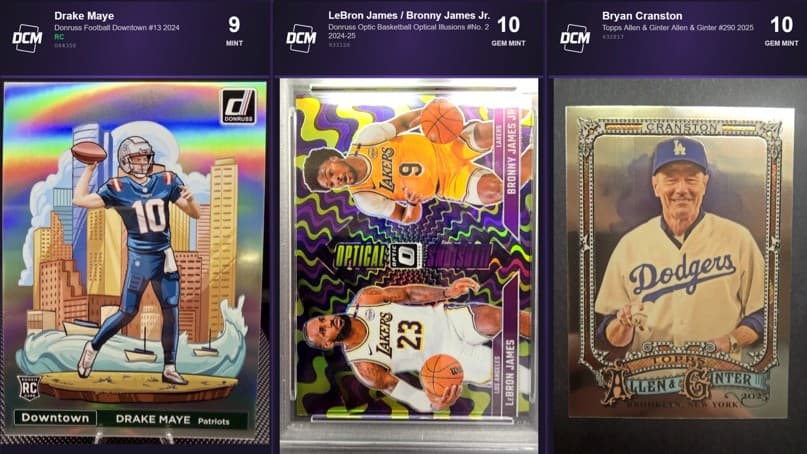
From rookie cards to vintage finds, learn how condition impacts value
Quick answer
Sports card grading assesses four things: centering, corners, edges and surface, on a scale of 1 to 10. Vintage cards are judged with their era's print quality in mind, junk wax era cards are common enough that only high grades matter, and modern cards are expected to be near perfect. Condition is what separates a hundred-dollar card from a million-dollar one.
Understanding Sports Card Grading
The sports card market has grown fast in recent years, and record sales keep making headlines. A PSA 10 2003 LeBron James Topps Chrome rookie sold for over $1.8 million. A Mickey Mantle 1952 Topps reached $12.6 million. So what separates a million-dollar card from a hundred-dollar card of the same player?
Almost always, it comes down to condition.
The Four Pillars of Card Grading
Every major grading company evaluates cards on four primary criteria.
1. Centering
Centering measures how well the card's image is positioned within its borders. Perfect centering means equal borders on all sides.
Grading standards:
- Gem Mint (10): 50/50 or 55/45 centering
- Mint (9): 55/45 to 60/40 centering
- Near Mint-Mint (8): 65/35 centering acceptable
- Below 8: Increasingly off-center
Sports cards, especially vintage ones, often have centering issues because of the printing technology of the era. A 1986 Fleer Michael Jordan with 70/30 centering might grade a 7 even with perfect corners.
2. Corners
Corners are usually the first area to show wear on sports cards. Graders examine all four under magnification, looking for:
- Sharp corners: crisp, pointed edges (Gem Mint)
- Slight rounding: barely perceptible wear (Mint)
- Fuzzy corners: visible softening (NM-MT to NM)
- Dinged corners: obvious damage (EX and below)
Pro tip: check corners against a dark background to spot subtle whitening.
3. Edges
The edges of your card tell the story of how it has been handled. Look for:
- Edge whitening (chipping of the color layer)
- Rough cuts from manufacturing
- Dings from stacking or storage
- Separation of card layers
Vintage cards often have rougher cuts than modern cards, and graders account for era-appropriate standards.
4. Surface
Surface condition covers everything on the face and back of the card:
- Scratches: especially visible on foil and chrome cards
- Print defects: spots, lines, or missing ink
- Staining: water damage, age spots
- Creases: any bending of the card
- Wax stains: common on vintage cards from pack wax
Chrome and Prizm cards are notoriously hard to find scratch-free, even straight from the pack.
Era-Specific Considerations
Vintage Cards (Pre-1980)
 Willie Mays 1972 DCM
Vintage sports cards face challenges modern cards do not:
- Wax stains from pack packaging
- Gum stains from included bubble gum
- Paper quality was lower, which made cards easier to damage
- Centering was often poor because of printing limitations
Graders use era-appropriate standards, so a 1955 Topps Roberto Clemente is not held to the same centering standards as a 2023 Topps card.
Junk Wax Era (1987-1994)
 Michael Jordan 1986 DCM
The overproduction era created billions of cards, but condition still decides value:
Michael Jordan 1986 DCM
The overproduction era created billions of cards, but condition still decides value:
- Many were poorly stored
- Off-center examples are common
- High-grade examples of key rookies (Griffey, Jordan, and so on) still command premiums
Modern Era (1995-Present)
Today's cards present different challenges:
- Print runs are more controlled
- Quality control is higher
- Surface scratches on chrome and foil are the biggest issue
- Pack fresh does not always mean Gem Mint
Using DCM for Sports Card Grading
Before spending $20 to $150 per card on mail-away grading, use DCM to:
- Sort your submissions. Find out which cards have Gem Mint potential.
- Document condition. Get a detailed analysis for insurance or sales.
- Price accurately. Know what grade to expect before you set a price.
- Work through a collection. Assess a large stack quickly.
 Drake Maye Downtown Full Report DCM
What DCM Analyzes on Sports Cards
DCM Optic examines your sports cards for:
- Centering measurements, front and back
- Corner sharpness at all four points
- Edge condition and whitening
- Surface scratches, print defects, and creases
- An overall grade with a confidence level
Tips for Better Grades
- Handle with care. Hold cards by the edges, with clean hands.
- Store them properly. Penny sleeves plus top loaders, at a minimum.
- Control the climate. Avoid humidity and temperature extremes.
- Buy graded when you can. On high-value cards, the premium is usually worth it.
- Sort before you submit. Use DCM so you are not paying fees on cards that were never going to grade well.
The Investment Perspective
If you treat cards as an investment, the grade is most of the math. These are rough market patterns for graded cards, not a promise about any one card:
| Grade | Typical Value Multiple |
|---|---|
| DCM 10 | 3-10x Raw Value |
| DCM 9 | 2-3x Raw Value |
| DCM 8 | Base market value |
On key cards, a single grade point can mean thousands of dollars.
Start Grading Today
Ready to go through your sports card collection? DCM gives you a condition analysis in about a minute, so you can make informed decisions about your cards.
Whether you are deciding which cards to submit for professional grading or you are just curious how your collection holds up, the report gives you something to work from.
Grade your first sports card free. Sign up now and see how your cards read.
Frequently asked questions
- What are the four grading criteria for sports cards?
- Centering, corners, edges and surface. Each is scored separately and the final grade reflects the weakest of them.
- What centering does a Gem Mint 10 need?
- Commonly 55/45 or better on the front, with the back allowed a looser ratio. Standards vary by company.
- Are junk wax era cards worth grading?
- Rarely, unless the card is a key rookie in a 9 or 10. Print runs from 1987 to 1994 were so large that mid grades trade for little.
- How does DCM grade sports cards?
- From front and back photos, with the same four criteria, subgrades for both sides and a written reason for each deduction, in about a minute.