Is AI Card Grading Accurate? What the 2026 Data Shows
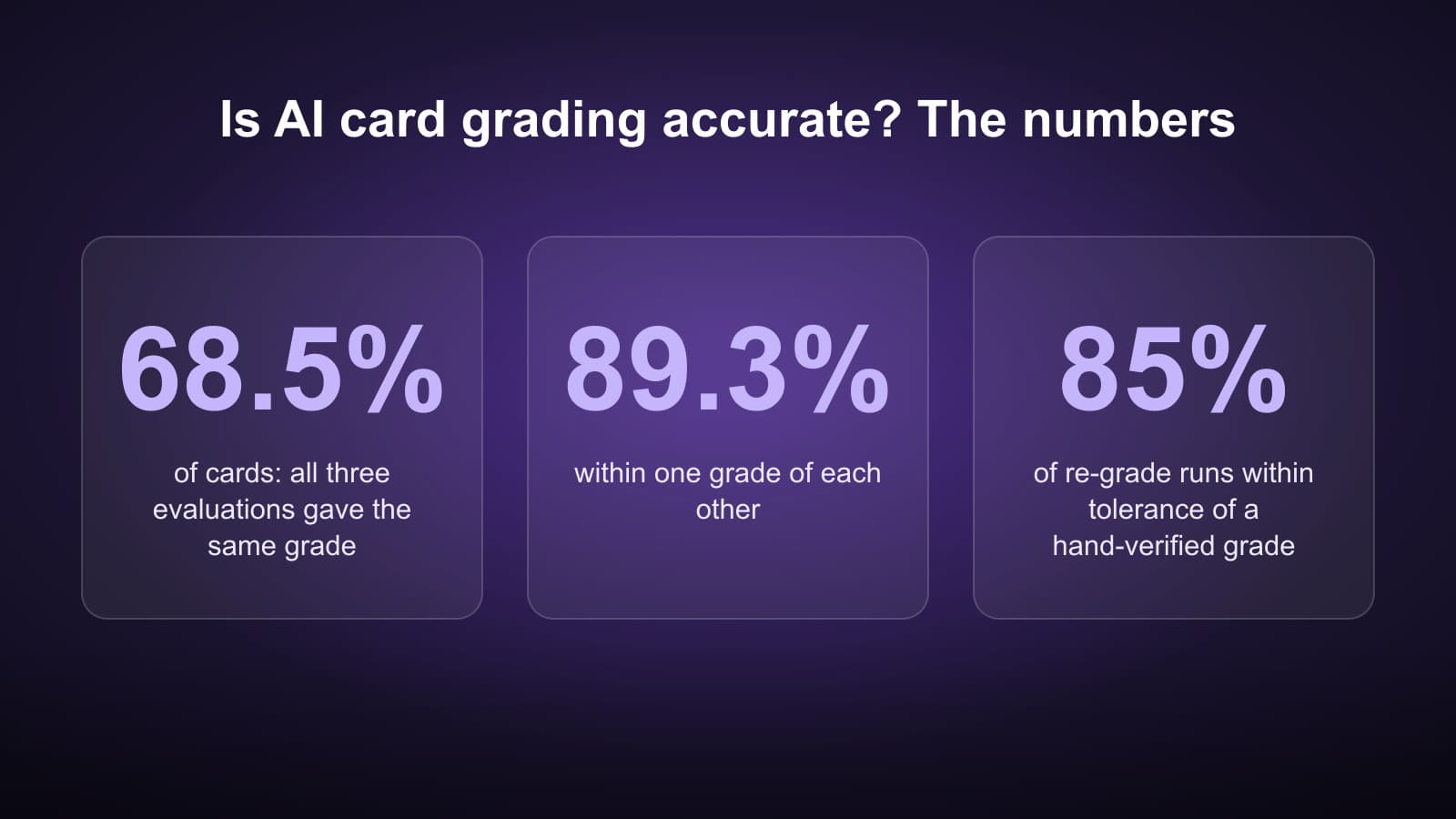
Three statistics on AI grading accuracy: 68.5% of cards with three matching evaluations, 89.3% within one grade, 85% of re-grade runs within tolerance
Agreement rates on 600 cards, a hand-verified re-grade test, what a photo cannot see, and how to check any AI grade yourself.
Quick answer
AI card grading is accurate enough to document a card's condition from good photos and not accurate enough to replace a physical inspection. On a 600-card sample graded September 8 to October 7, 2026, DCM Optic's three independent evaluations gave the same final grade for 68.5% of cards and landed within one grade for 89.3%. In an August 2026 test against hand-verified reference grades, 85% of runs fell within tolerance, with an average error of 0.61 grades. Accuracy depends on photo quality, and no photo can establish authenticity.
Short answer: AI card grading is accurate enough to be useful and not accurate enough to be trusted blindly, and the difference between the two is mostly the photos. This article gives the numbers behind that answer, what they do not prove, and how to check any AI grade, including ours.
Two different questions
"Is it accurate?" is really two questions.
- Consistency: does it give the same card the same grade each time?
- Correctness: does the grade match the card's true condition?
A tool can be consistent and wrong. Both have to be measured, and we measure them differently.
Consistency: 600 cards, three evaluations each
Every DCM grade is the median of three independent evaluations of the same photos. That means we have, for every card, a built-in consistency test.
 Bar chart of how far apart three DCM Optic evaluations landed on 600 cards
On a sample of 600 cards drawn at even intervals from the 6,842 graded between September 8 and October 7, 2026:
| Spread between the three evaluations | Share of cards |
|---|---|
| All three gave the same grade | 68.5% |
| Within one grade | 89.3% |
| Two grades apart | 6.0% |
| Three or more apart | 4.7% |
 Bar chart: 12.1% of single evaluations differed from the published grade, 3.1% by two grades or more
Looked at one evaluation at a time, 12.1% disagreed with their card's published grade and 3.1% disagreed by two grades or more. That is why no DCM grade comes from a single evaluation: the median of three removes the outliers before a customer sees the number. The full method and its limits are in our repeatability data.
Correctness: a hand-verified test
In August 2026 we re-graded 11 cards with hand-verified reference grades three times each with the full production pipeline.
| Measure | Result |
|---|---|
| Runs within tolerance of the hand-verified grade | 28 of 33 (85%) |
| Average distance from the hand-verified grade | 0.61 grades |
| Average spread between runs of the same card | 0.55 grades |
It is a small sample and it was built to compare two image settings rather than to measure accuracy on its own, so read it as a direction: most runs land on or next to the reference grade, and the misses are usually one grade. We also test engine changes against a deliberately hard set of hand-verified cards before release, and on that adversarial set exact-match rates are well below the figures above, because it is built from the cards that are hardest to call.
What the numbers do not prove
- Agreement is not correctness. Three evaluations can agree on the wrong answer.
- New photos can change the grade. The sample above re-used the same photos. A reshoot in different light can reveal or hide a defect, and we have not yet published a reshoot study.
- Nothing about other graders. DCM grades against its own standard. None of this predicts what PSA, BGS, SGC or CGC would say.
What a photo can and cannot see
 Two-column graphic of what photo grading measures well and what a photo cannot establish
Photo grading measures centering, corner and edge wear, and surface defects that catch the light well. It cannot establish authenticity, cannot rule out a clean trim, and cannot see through glare, a sleeve or a holder. The honest version of "is AI grading accurate" always includes that list, which is why it is published at grading limitations.
The photos decide more than the engine does
The single biggest driver of accuracy in our data is the photo. Every DCM report carries an image confidence letter from A (the whole card clearly visible) to D (retake recommended). On about one card in five, the photos limit what the engine can see, and the report says so rather than guessing. What image confidence means explains the letter, and the lighting guide shows how to get an A.
How to check any AI grade yourself
- Read the standard. If the rules are not published, the grade is not interpretable.
- Read the reasons. A grade with no written deductions cannot be checked. DCM reports name the defect and where it is.
- Check the confidence rating. If the tool does not tell you when the photos were poor, assume it graded them anyway.
- Look at the photos the tool graded. Every DCM report page shows them.
If a grade still looks wrong, request a review from the card page. The AI card grading accuracy page tracks the current figures, and can AI be as accurate as humans covers the comparison with human graders.
Figures from DCM production records (600 of 6,842 cards, September 8 to October 7, 2026) and an internal August 2026 test on 11 hand-verified cards. Last updated October 2026.
Frequently asked questions
- How accurate is AI card grading?
- On a 600-card sample from September and October 2026, DCM Optic's three independent evaluations gave the same final grade for 68.5% of cards and landed within one grade for 89.3%. In an August 2026 test on hand-verified cards, 85% of runs fell within tolerance of the reference grade, with an average error of 0.61 grades. Photo quality is the biggest factor.
- Can AI grading replace PSA or another grading company?
- No. AI grading documents condition from photos against a published standard. A mail-in grader physically examines, authenticates and encapsulates the card. DCM grades do not predict another company's grade. Many collectors use an AI grade to decide which cards are worth a mail-in fee.
- What can AI card grading not see?
- Authenticity of the card or a signature, a trim that leaves a clean edge, defects hidden by glare, a sleeve or a holder, and anything a different angle of light would reveal. Every DCM report carries an image confidence letter that says how much of the card the photos showed.
- How can I check whether an AI grade is right?
- Read the published grading standard, read the written reasons for every deduction, check the confidence rating for the photos, and look at the photos the tool graded. On DCM all four are on the public report page, and you can request a review from the card page.