How to Evaluate an AI Card Grade: Consistency, Confidence and Limits
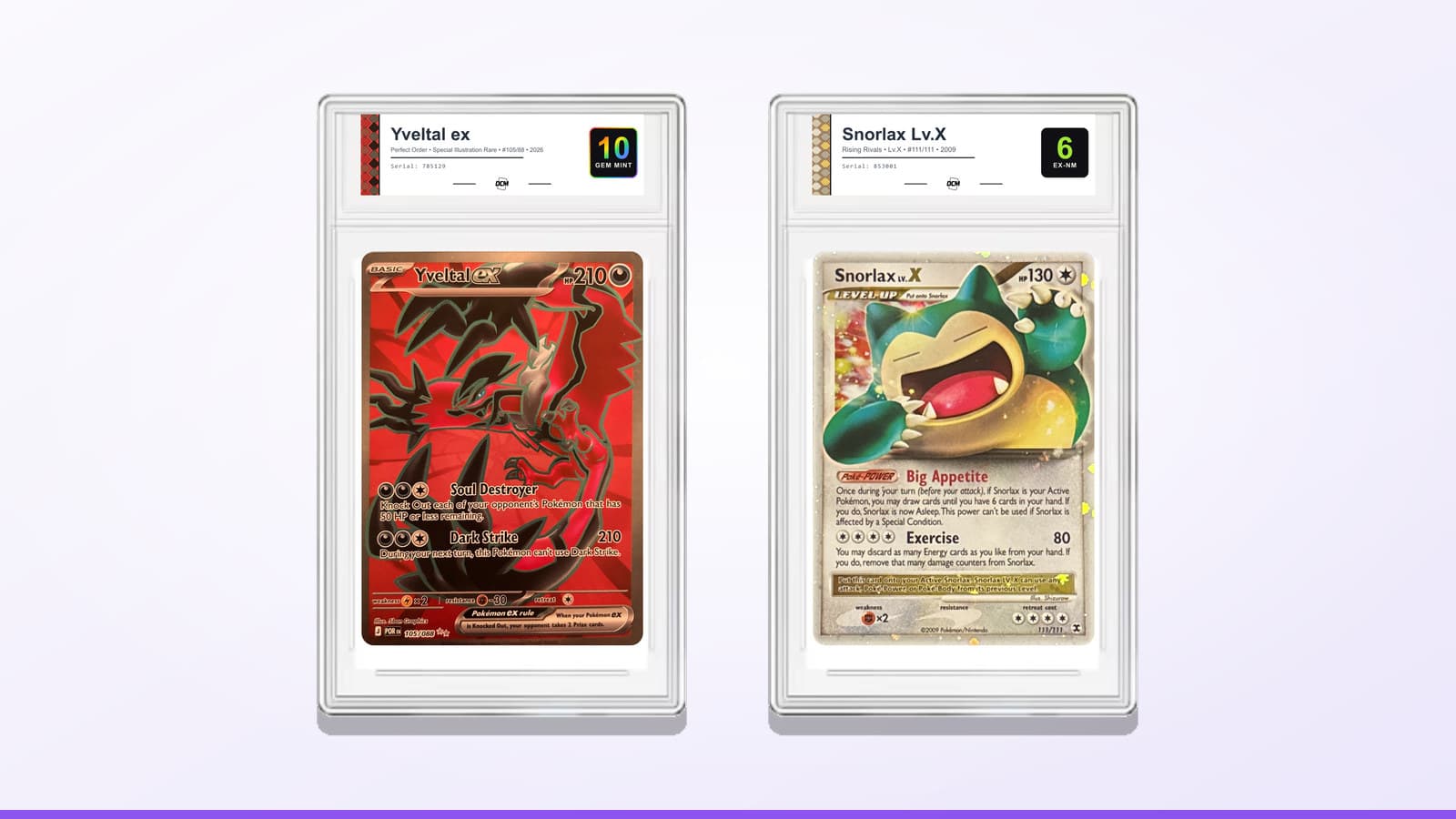
Yveltal ex (Perfect Order Special Illustration Rare #105/88, 2026) graded DCM 10 Gem Mint beside Snorlax Lv.X (Rising Rivals #111/111, 2009) graded DCM 6, in DCM Heritage label slabs
Four things to check before you trust any AI card grade, including ours.
Quick answer
To evaluate an AI card grade, check four things: a published grading standard, a way of handling disagreement such as multiple evaluations with a median, a confidence rating that tells you how much of the card the photos showed, and a clear statement of what photos cannot establish, such as authenticity. On a DCM report, the image confidence letter A to D measures photo visibility, not certainty about the physical card.
AI card grading apps are easy to find and hard to compare. Most will happily give you a number. Fewer will tell you how they got it, how often they would give you a different number, or what they cannot see. Those three things are what separate a useful grade from a guess.
Here are four checks that work on any AI grade, and how to read each one on a DCM report.
1. Are the rules published?
A grade is only meaningful against a standard. Look for a public rubric that says how each category is scored and how the categories become a final grade.
On DCM: the DCM Grading Standard is public. Every card is scored on centering, corners, edges and surface for both faces, and the final grade is the lowest category, not an average. The full order of operations is in how DCM Optic produces a grade.
2. How does it handle disagreement?
AI models are not perfectly repeatable. Ask the same model the same question twice and you can get two answers. A trustworthy service plans for that instead of hiding it.
On DCM: every card gets three independent evaluations and the median becomes the grade. On 600 recent cards, the three agreed on the final grade 68.5% of the time and landed within one grade 89.3% of the time. The full numbers, method and limits are in our repeatability data.
A useful habit: if a card sits right on the line between two grades, expect that a re-grade, especially from new photos, could land one point either side.
3. What does the confidence rating actually measure?
This is the most misunderstood part of any AI grade.
 Image confidence letters A to D with photo uncertainty of plus or minus 0, 1, 2 and 3: A whole card clearly visible, B minor glare or softness, C moderate glare, blur or obstruction, D retake recommended
On DCM: the letter from A to D measures how much of the card your photos let us see. An A means the whole card was clearly visible. A C means glare, blur or an obstruction hid part of it. The plus-or-minus range next to the letter, from ±0 at A to ±3 at D, is the photo uncertainty.
What the letter does not mean: an A is not a promise that the grade is correct, and it says nothing about the physical card beyond what was photographed. A clear photo of a card can still miss a scratch that only shows at a certain angle of light.
How to use it: if your report shows a C or D, retake the photos before you rely on the grade. Our photography guide covers lighting and angles.
4. What does it admit it cannot see?
Every photo-based grade has limits. The honest ones say so.
 Three lower-grade cards in DCM Heritage label slabs: 1999 Base Set Ninetales graded DCM 7 Near Mint, 2009 Rising Rivals Snorlax Lv.X graded DCM 6, and 1954 Topps Willie Mays graded DCM 5 Excellent
On DCM: a photograph cannot establish:
- whether a card is genuine or has been altered, so DCM does not authenticate cards;
- card thickness, warping or texture you would feel in hand;
- some surface defects that only appear at a particular light angle.
Lower grades are where this matters most, so read the written reasons. 1999 Base Set Ninetales graded 7: noticeable whitening at the bottom-left corner on the back, so corners and edges set the grade. 2009 Rising Rivals Snorlax Lv.X graded 6: noticeable whitening along the bottom edge on the front, so edges set the grade. 1954 Topps Willie Mays graded 5: noticeable whitening at the top edge on the back, and the report notes that photo quality limits how confidently the card could be assessed. Every deduction on a DCM report comes with a reason you can check against the photos.
More detail is on our grading limitations page.
A quick checklist
| Check | What good looks like | Where to find it on DCM |
|---|---|---|
| Published rules | Public rubric, final-grade rule stated | Grading Standard |
| Disagreement handling | Multiple evaluations, median or similar | Repeatability data |
| Confidence rating | Explains what it measures | Image confidence letter on every report |
| Stated limits | Says what photos cannot show | Grading limitations |
| Verifiable result | Public report with the graded photos | Public DCM card pages and the label QR code |
None of these checks tell you what another grading company would give your card, and no AI grade should claim to. They tell you whether the grade in front of you was produced carefully and can be checked.
Frequently asked questions
- What does the DCM image confidence letter mean?
- It measures how much of the card your photos let DCM see, from A (whole card clearly visible, photo uncertainty ±0) to D (retake recommended, ±3). It is not a guarantee that the grade is correct and says nothing about what the photos do not show.
- Can an AI card grader authenticate a card?
- Not from photos. A photograph cannot prove a card or signature is genuine or unaltered. DCM does not authenticate cards; its grade describes the visible condition in the photos.
- Should I trust an AI grade on a borderline card?
- Treat it as a strong indication, not a certainty. A card on the line between two grades can land one point either side on a re-grade, especially from new photos. Check the image confidence letter and the written reasons for each deduction.
- Does a DCM grade predict a PSA grade?
- No. DCM grades against its own published standard and makes no claim about the grade any other company would assign.