Card Centering Standards Compared: PSA, BGS, CGC, SGC and DCM
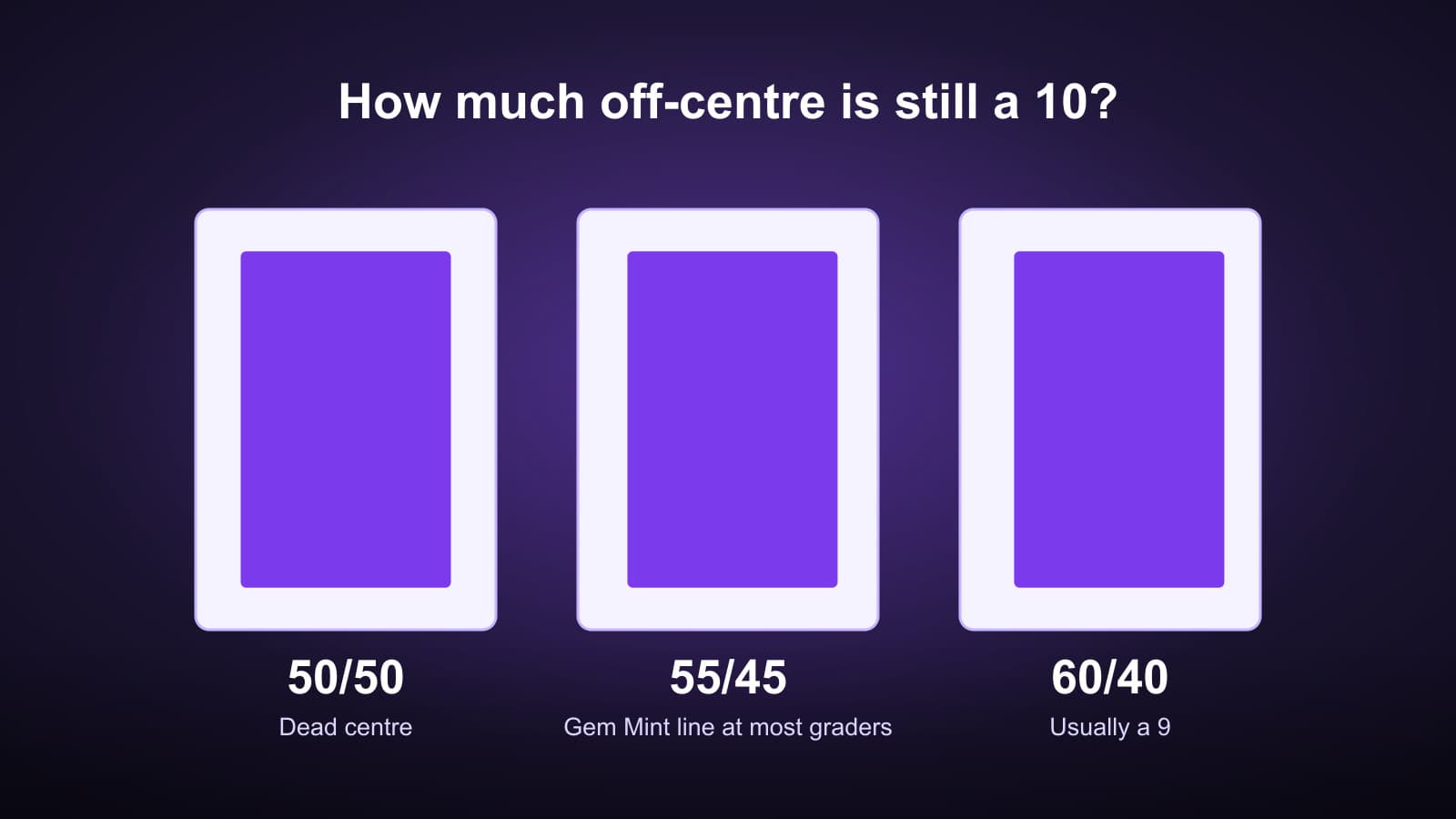
Three schematic cards showing 50/50, 55/45 and 60/40 centering
How much off-centre a card can be and still grade a 10 at each company, how the ratio is measured, and why the same card can be a 10 at one and a 9 at another.
Quick answer
Most grading companies allow about 55/45 front centering for a Gem Mint 10 and about 60/40 for a Mint 9. PSA and CGC allow 75/25 on the back at Gem Mint; BGS allows 60/40 on the back at Gem Mint 9.5. Pristine tiers at BGS, CGC and SGC require 50/50. DCM requires 55/45 or better on every axis of both faces for a 10, 56/44 to 60/40 for a 9 and 61/39 to 65/35 for an 8, with each category scored as the lower of front and back.
Centering is the one grading category you can measure with a ruler, which makes it the easiest to argue about. The argument usually comes down to a simple fact: every grading company publishes its own cutoffs, and they are not the same.
This article puts the standards side by side. For what the ratio means and why DCM treats centering as a cap on the whole card, start with card centering explained.
How the ratio is measured
 Diagram showing how left and right borders are measured and turned into a 58/42 centering ratio
Measure the left and right borders, add them, and express each as a share of the total. Do the same top to bottom. A card is described by its worse axis, larger side first, so a card at 58/42 left-right and 51/49 top-bottom is a 58/42 card.
Two things trip people up. First, measure the border to the printed edge of the design, not to the artwork inside it, because full-art cards have no inner frame to judge. Second, measure from a photo taken straight on. Shooting at an angle makes one border look wider than it is, which is the most common reason an owner's ruler and a grader's disagree.
The standards side by side
 Table of front centering allowed at the top grades by PSA, BGS, CGC, SGC and DCM
| Company | Top tier | Gem Mint tier | Next grade down |
|---|---|---|---|
| PSA | Gem Mint 10 | 55/45 front, 75/25 back | Mint 9: 60/40 front, 90/10 back |
| BGS (Beckett) | Pristine 10: 50/50 front, 55/45 back | Gem Mint 9.5: 55/45 front, 60/40 back | Mint 9: 60/40 front |
| CGC Cards | Pristine 10: 50/50 | Gem Mint 10: 55/45 front, 75/25 back | Not published as a ratio |
| SGC | Pristine 10: 50/50 | Gem Mint 10: 55/45 | Mint 9: 60/40 |
| DCM | Gem Mint 10 | 55/45 on every axis, both faces | Mint 9: 56/44 to 60/40 |
PSA's published standard also allows a small variance at the grader's discretion based on eye appeal, and SGC is widely reported to weigh eye appeal more than a strict ratio. CGC publishes Pristine and Gem Mint as ratios and describes its lower grades in words. The figures for PSA, BGS, CGC and SGC are as published on their sites or reported by third parties in October 2026; confirm on each company's own standards page before you submit, because they change.
What is the same and what is different
The same: the Gem Mint front line sits at about 55/45 everywhere, and about 60/40 is a 9. On the front of the card, the companies broadly agree.
Different: the back. PSA and CGC accept a back as far off as 75/25 at Gem Mint. BGS wants 60/40 on the back for a 9.5. DCM holds the back to the same ratio as the front, and because each category scores as the lower of the two faces, a card with a 55/45 front and a 70/30 back is a centering 7 on DCM. That is the single biggest reason a card can carry a PSA 10 and grade lower here, and it is by design: a buyer flipping the card sees the back too.
Also different: the Pristine tiers. BGS, CGC and SGC each have a grade above Gem Mint that requires 50/50, which almost no mass-produced card achieves. DCM's scale tops out at 10.
DCM's full centering scale
From the DCM Grading Standard, applied to every axis of both faces:
| Centering | Score |
|---|---|
| 55/45 or better | 10 |
| 56/44 to 60/40 | 9 |
| 61/39 to 65/35 | 8 |
| 66/34 to 70/30 | 7 |
| 71/29 to 80/20 | 6 |
| 81/19 to 85/15 | 5 |
| 86/14 to 90/10 | 4 |
| 91/9 to 95/5 | 3 |
| Worse than 95/5 | 2 |
| Miscut | 1 |
The final grade is the lowest of the four categories, so centering can cap a card that is otherwise perfect. Every DCM report states the measured ratio for each face, and if you think the measurement is wrong you can request a review from the card page.
Which standard should you measure against?
The one belonging to the company you plan to submit to. If you are deciding whether a card is worth a mail-in fee, grade it on DCM first: the report gives you the ratio on both faces in about a minute, and you can read it against any company's table above before you spend $20 to $80 and a few months on a sealed slab.
Standards for other companies are quoted from their published pages and third-party reports as of October 2026 and may change. DCM grades against its own standard and does not predict another company's grade.
Frequently asked questions
- What centering is needed for a PSA 10?
- PSA publishes approximately 55/45 on the front and 75/25 on the back for Gem Mint 10, with a small variance allowed at the grader's discretion for eye appeal. Mint 9 is about 60/40 front and 90/10 back. Confirm on PSA's grading standards page before submitting.
- What centering does DCM require for a 10?
- 55/45 or better on every axis of both the front and the back. 56/44 to 60/40 scores a 9, 61/39 to 65/35 an 8, and 66/34 to 70/30 a 7. Each category takes the lower of its front and back score, and the final grade is the lowest category.
- Why does DCM hold the back to the same centering as the front?
- Because each category on a DCM report scores as the lower of the two faces, and a buyer sees both. PSA and CGC accept a back as far off as 75/25 at Gem Mint, which is the most common reason a PSA 10 can grade lower on DCM.
- How do I measure centering myself?
- Photograph the card straight on, measure the left and right borders to the printed edge of the design, add them, and express each as a share of the total. Repeat top to bottom. The worse of the two axes, written larger side first, is the card's centering.