Why Do Foil Trading Cards Curl, and How Does Curling Affect Grading?
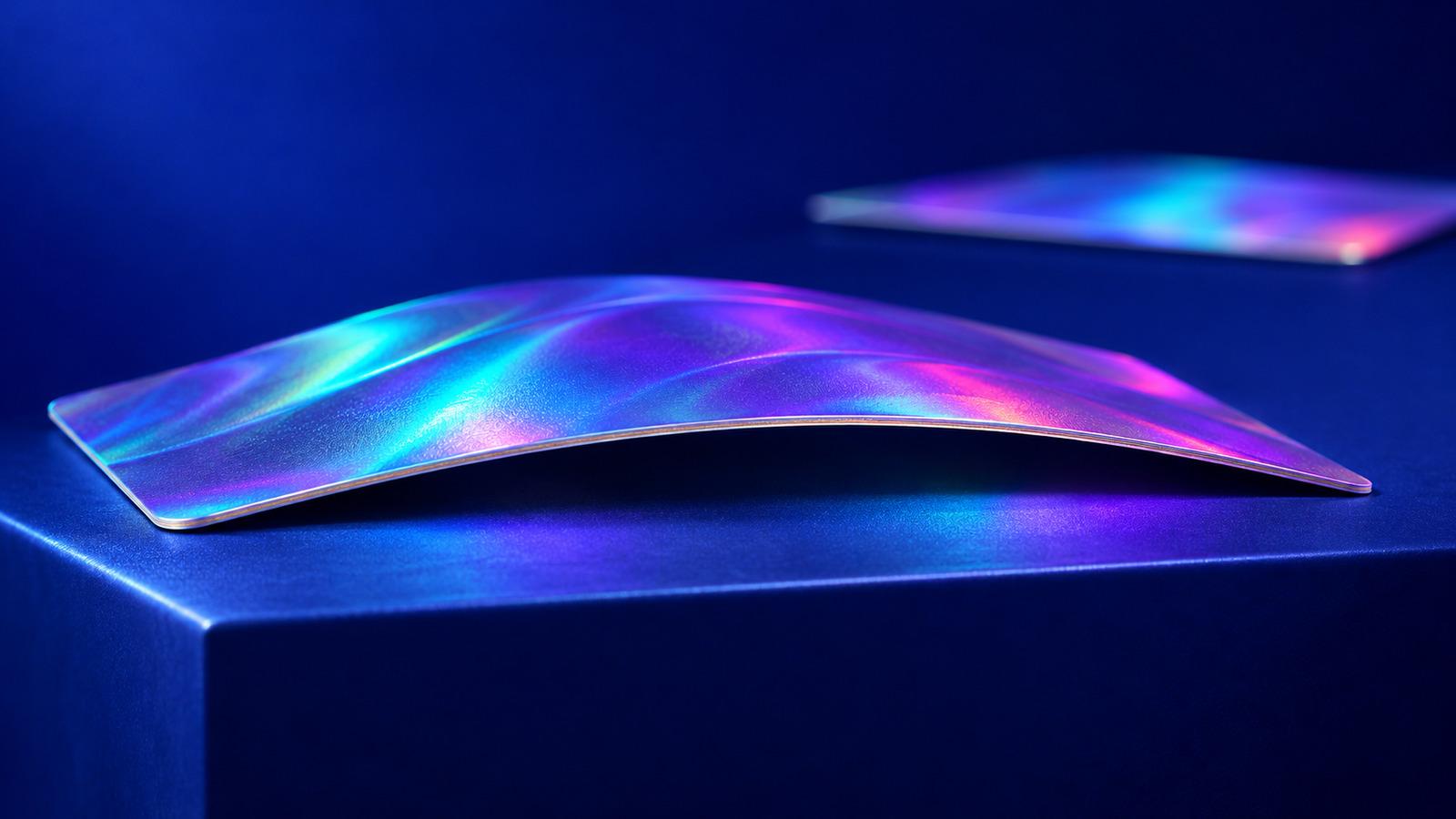
AI-created conceptual illustration of a smoothly bowed holographic card on a cobalt-blue surface; not a measured grading example.
A smooth bow, a hard crease and a surface dent are different problems. Here is how to inspect and document them without forcing a card flat.
Quick answer
Foil cards can curl when their layered materials respond differently to changes in the environment. A smooth bow is different from a crease, dent or broken surface. There is no universal grade deduction for every curved card: assessment depends on the physical condition and the grader’s standards, and straight-on photos may conceal the curve.
You open a pack, sleeve the foil, and later notice that it no longer sits flat. The edges look clean and the surface seems untouched. Does that make it damaged, and does it rule out a strong grade?
First separate the shape of the card from damage to its stock. A broad, smooth curve and a sharp fold are not the same observation. Neither should be hidden by pressing the card flat for a photograph.
First, change the viewing angle
A frontal image can make a curved card look ordinary. A separate side profile answers a different question. Keep both observations instead of forcing the card flat to make the photos agree.
 Front and side schematics show how a curved card can have an ordinary-looking frontal outline while its bow is obvious in profile.
Why do foil cards curl?
Cards are layered objects. When those layers respond differently to changes in their surroundings, the card can bow. Wizards of the Coast’s discussion of card coatings explains that Magic’s laminated paperboard is sensitive to humidity and temperature and that coatings affect stability.
That helps explain why storage environment belongs in the conversation. It does not establish an exact humidity target, a guaranteed flattening procedure or a measured curl rate for every set. Different card constructions and finishes need not behave identically.
 Conceptual exploded diagram of a surface finish, paper-based structure and opposite face. Layer proportions are illustrative and vary between products.
For a broader look at the material, Wizards also discusses playing-card board. A foil’s appearance alone cannot tell you how it was stored or whether a prior owner attempted a treatment.
Diagnose the observation: curl, crease or dent?
 Schematic side profiles: flat card, broad smooth bow, and localized crease. The drawing illustrates shape differences and is not a grading tolerance or a real-card measurement.
| Observation | What to inspect next | What to record |
|---|---|---|
| Broad, smooth bow | Both faces and the edges under angled light | Direction of curvature and whether a line or break is visible |
| Sharp localized bend | The corresponding area on the other face | Location, visible line and any surface disruption |
| Dent or impression | Reflected light across the mark | Size, position and whether it is visible from both sides |
| Peeling or separation | Edges and coating continuity | Where layers appear to lift; avoid handling the area |
The diagrams are deliberately schematic. They are not evidence that a particular height of curl receives a particular grade.
Then ask the grading question
There is no company-independent answer. A grader evaluates the actual card under its own standard. A smooth bow does not automatically prove a crease, and it does not guarantee that the card will receive a top grade either.
Published scales such as PSA’s standards and CGC’s grading scale describe condition expectations, but should not be converted into an invented “millimeters of curl to grade” chart. For a strongly bowed or unusually thick card, ask the intended service about assessment and holder suitability.
A card’s playability is also a separate question from its collector grade. If curvature makes a card distinguishable in a deck, ask the event’s judge about that event’s rules instead of using a grading label as permission to play it.
How should you photograph a curved foil?
 Photo plan for a curved foil: straight-on front, straight-on back, side profile, and angled light for the surface. Do not flatten the card to conceal its shape.
Take clear front and back photos for the condition record, plus a separate side view that shows the natural shape. Tilt gently under soft light to inspect for scratches or creases. Keep those additional images for your records or for a physical grader even if an upload workflow only accepts front and back images.
Do not press the card with a finger, glass sheet or heavy object to make it look flat. That hides evidence and can introduce marks. A glare-free front view can still miss curvature, which is one of the practical limits of grading from photographs.
Our lighting guide explains how to make reflective surfaces visible. DCM’s grading limitations explain why visible condition and physical examination are not interchangeable.
What should you do about storage?
Use compatible sleeves and holders in a stable indoor environment. Avoid direct sunlight, heaters, damp areas and a car’s temperature swings. Check that a rigid holder can accommodate the card without clamping or forcing it.
Do not assume a desiccant pack is a universal cure, or that adding moisture is safe. Deliberately changing humidity without a controlled method can create another problem. Heat, ironing, steaming and heavy pressing can damage a card or affect a grader’s alteration assessment.
Should you grade it now?
Start with your goal. For a collection record, document the curve honestly along with the visible surface. For a sale, show the profile and describe it. For a mail-in submission, confirm the service’s policy and inspect for a crease before spending the fee.
DCM can document what suitable photos reveal, but cannot infer a hidden side profile from a flat-looking image or predict another company’s grade. Keep the physical evidence with the record. If the card matters enough that curvature changes the decision, a hands-on assessment is the useful next step.
Header artwork is an AI-created editorial illustration. Its fictional cards and scenes are not product references, condition-test results or authentication evidence.
Frequently asked questions
- Does a curled foil card count as creased?
- Not automatically. A broad smooth curve differs from a sharp localized fold or broken surface. Inspect both faces and the side profile before describing the condition.
- Can a pack-fresh foil card be curved?
- Yes. Pack-fresh describes how the card was obtained, not a guarantee that it is flat or free of manufacturing and handling defects.
- Can I iron or press a foil flat before grading?
- Do not use heat or pressure treatments to improve its grading appearance. They can damage the card or affect an alteration assessment. Ask the intended grader about a strongly curved card.
- Can photo grading see card curling?
- Straight-on photos can hide curvature. Keep a side-profile image and do not assume a condition report based on front and back photos establishes flatness.