Should You Clean Trading Cards Before Grading? Cleaning, Restoration and Alteration
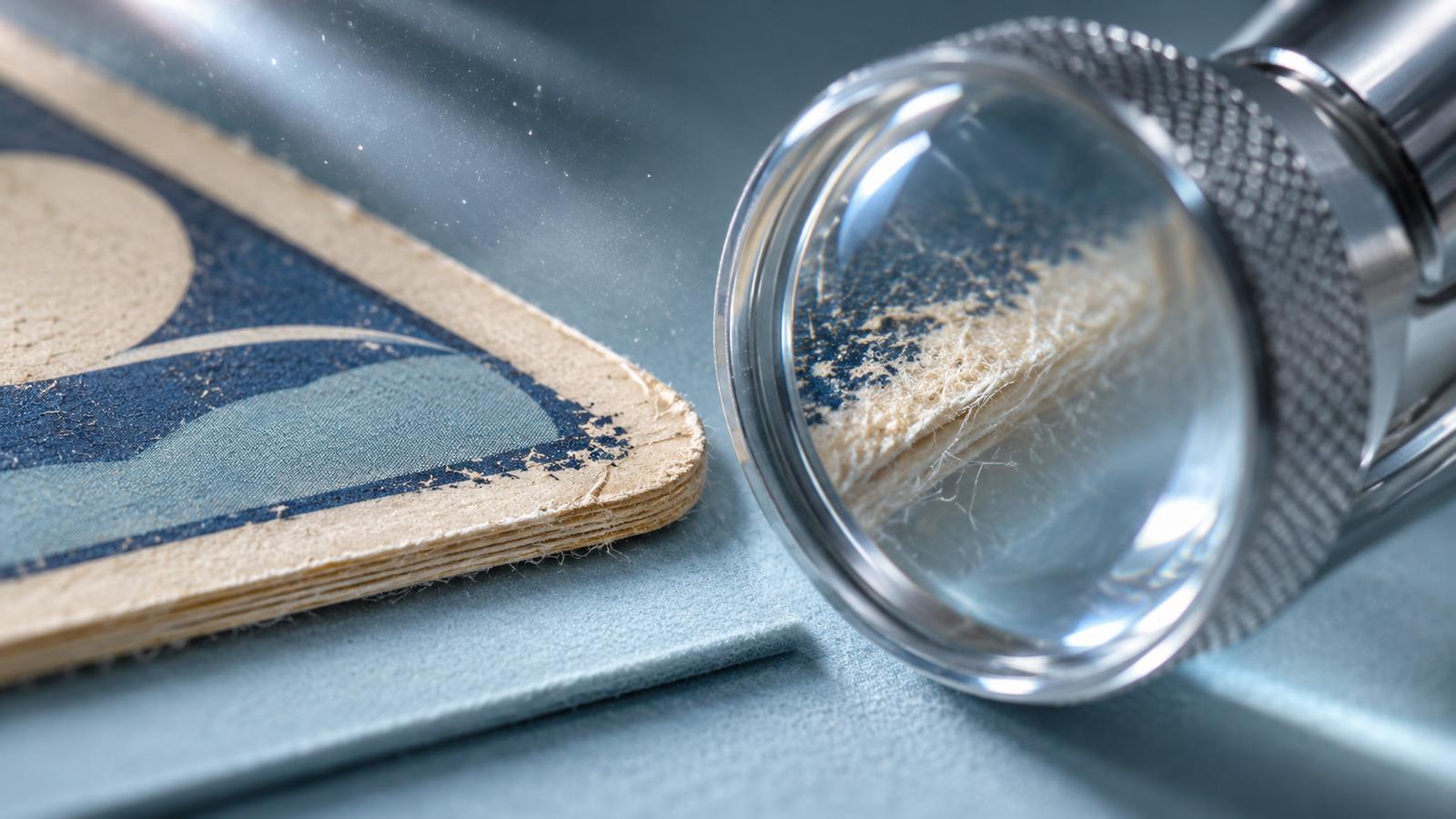
AI-created editorial macro illustration of a worn paper-card corner and an inspection loupe; not a real condition test.
A better-looking surface can be a changed surface. Know the difference between careful preparation and treatments a grader may classify as alteration.
Quick answer
Do not apply cleaners, polish, wax, solvents or pressure treatments to a card just to improve its grade. Graders may classify cleaning, restoration and surface changes as alteration. Prepare a clean workspace, inspect the card as it is, and check the receiving company’s current policy before any treatment.
A scratch is frustrating because you can see exactly where the better grade went. A cleaning video makes the next step look easy: wipe, polish, press, submit. The missing step is asking whether the finished card is still eligible for the grade you wanted.
This guide is about preparing a card for assessment, not a recipe for restoring one. If the goal is a numeric grade on an unaltered card, preserving the original surface matters more than making a defect less visible in a photograph.
Start with the mark, not a cleaning product
The first branch is observational: are you looking at the card, the sleeve or a reflection? Change the evidence before changing the object.
 Inspection decision tree: determine whether a mark is on the holder or card, document it without rubbing, and consult the intended grader when treatment or fragility matters.
Handling, cleaning and restoration are different actions
| Action | Why it matters |
|---|---|
| Cleaning the desk and camera lens | Improves handling and photography without treating the card |
| Replacing a dirty sleeve | Keeps residue away from the card; remove it carefully |
| Wiping or rubbing the card surface | Can abrade gloss, drag grit or change coatings |
| Applying liquid, wax or polish | Can leave residue or alter the surface |
| Pressing a crease or flattening with heat | Can change the stock and introduce damage |
| Recoloring or trimming | Changes the card itself rather than documenting its condition |
Even something marketed as “card safe” is not automatically approved by a grading company. A product maker’s claim and a grader’s submission policy answer different questions.
 Three levels of intervention: preparing the workspace, treating the card surface and changing the stock. Each affects a different part of the grading question.
What do PSA and CGC say?
The following is a summary of published policies reviewed on November 2, 2026. Confirm the applicable service before submitting a treated card.
| Company | Published treatment of alteration | Where to check |
|---|---|---|
| PSA | N5 covers altered stock, including pressing, scratch removal, enhanced gloss and applied substances. N7 addresses evidence of cleaning. Some outcomes may qualify for an Authentic Altered holder at PSA’s discretion and under its submission conditions. | PSA grading standards |
| CGC Cards | Its scale provides an Authentic Altered designation, including for trimming and recoloring. Acceptance depends on the card and service; an altered designation is not a numeric condition grade. | CGC grading scale |
CGC’s cards-we-grade page also discusses exclusions and treatment evidence. Because acceptance language can differ by service and card type, ask CGC directly about a previously treated card. Do not interpret the existence of an altered holder as approval of a particular cleaning process.
The tempting fix: can whitening or scratches be removed?
First establish what the mark is. Dust sitting on a sleeve is not the same thing as a scratch in the card. A reflection in plastic is not the same thing as a print line. Inspect the card outside its holder only when it can be removed safely, and compare under more than one lighting angle.
Whitening at a worn edge can expose the underlying paper. Removing that appearance by adding color does not restore the original printed edge. Likewise, a crease involves the structure of the card; making it flatter does not mean the original stock has been restored without alteration.
 Existing DCM macro examples of corner wear, edge wear, centering and surface texture. These are condition examples, not before-and-after cleaning results.
Our guide to the flaws behind a 9 shows real examples. A condition report is useful precisely because it describes what is present, rather than asking you to improve the appearance first.
Your preparation checklist
- Clear the work area and wash and dry your hands.
- Check the sleeve and holder for damage before removing the card.
- Inspect the front and back under diffuse light, then tilt gently to reveal surface marks.
- Take sharp photographs with a clean camera lens. Do not use filters or retouch flaws.
- Write down any known treatment history. If the card was treated before you owned it, state what you know and what remains uncertain.
- Select the appropriate next step: storage, a documented condition assessment, or a physical examination by the intended grader.
If debris or residue is adhered to the card, stop rather than scraping it. The point is to avoid turning an uncertain mark into a permanent problem.
What if the card has already been cleaned?
Keep an honest record of the treatment and any products used. Do not repeat treatments in an attempt to remove the evidence of the first one. Ask the intended grading company about the relevant service and disclose the history to a buyer when it affects the item’s description.
A sharp photograph cannot prove that a card is unaltered. DCM documents visible condition against its grading standard; it does not authenticate cards or guarantee the absence of treatment. The grading limitations explain what photographs can miss.
For better images, improve the lighting and focus using our card photography guide. Better evidence is the useful improvement you can make without changing the card.
Header artwork is an AI-created editorial illustration. Its fictional cards and scenes are not product references, condition-test results or authentication evidence.
Frequently asked questions
- Should I wipe my cards before grading?
- Do not assume wiping is harmless. Rubbing can drag grit or affect a surface coating. Clean the workspace and camera lens, inspect the card, and avoid treatments intended to change its appearance.
- Can polishing a card improve its grade?
- Polishing may change the surface and cause the card to be classified as altered rather than receive the numeric grade you expected. Check the receiving company’s current standards.
- Is pressing a crease considered alteration?
- PSA explicitly includes crease or wrinkle pressing in its altered-stock description. Other services have their own policies. A flatter card is not necessarily an unaltered card.
- Can DCM tell whether a card has been cleaned?
- A photograph may show residue or visible surface changes, but DCM cannot establish the absence of cleaning or authenticate the card. Disclose known treatment history and seek a physical review when needed.