How Long Does Card Grading Take? Turnaround Times in 2026, and the One-Minute Alternative
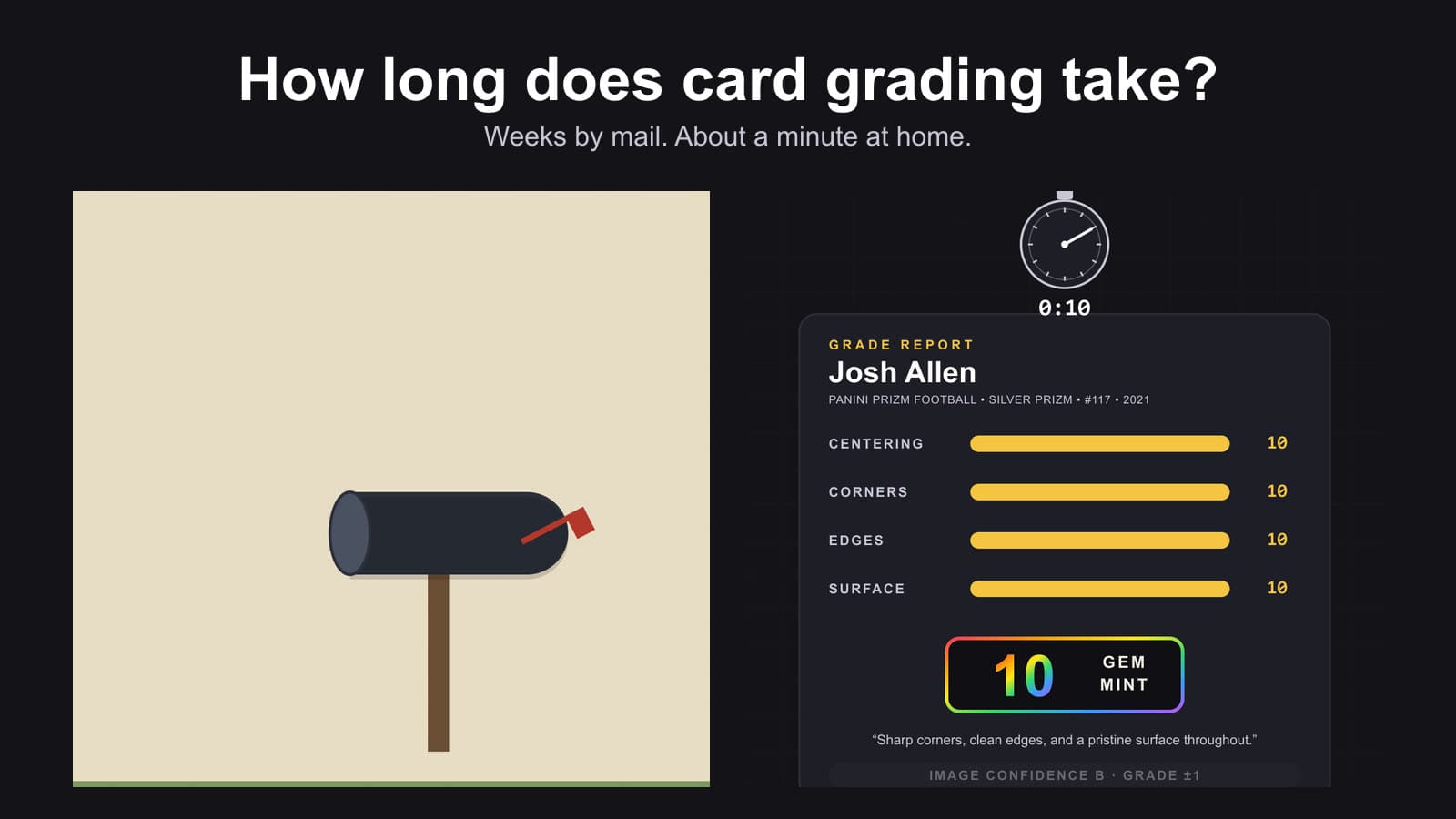
A mailbox with the flag up next to a DCM grade report showing four subgrades of 10 and a stopwatch reading ten seconds
The posted wait at every major service, where the weeks actually go, and what it looks like to grade the same card at home in about a minute.
Quick answer
By mail, card grading takes anywhere from about three weeks to more than six months depending on the company and the tier you pay for, plus shipping in both directions. As of October 8, 2026, the cheapest open single-card tiers post 15 to 100 business days. Grading the same card at home with DCM takes about a minute.
How long does card grading take? By mail, anywhere from about three weeks to more than six months depending on the service and the tier you pay for, and that is before you add shipping in both directions. At home with DCM, about a minute.
That is the short answer. The rest of this post is the long one: what each grading company is currently posting, where the weeks actually go, what the wait costs you beyond the fee, and what grading the same card at home looks like in practice.
The posted turnaround times, October 2026
These are the cheapest tiers open at each service for a single card, with the turnaround each company publishes, checked on each company's own site on October 8, 2026. All figures are business days, so a 40 day estimate is closer to eight calendar weeks. Shipping to the grader and back is not included, and every company says its estimates are not guaranteed.
| Service | Cheapest open tier | Published turnaround | Note |
|---|---|---|---|
| PSA | Standard, $59.99 per card | 90 to 100 business days | Value services are temporarily paused |
| BGS (Beckett) | Express, $79.95 per card | 15 business days | Base and Standard are temporarily paused |
| SGC | Standard, $50 per card | 40+ business days | No minimum |
| CGC | Economy, $20 per card | 90 business days | Bulk is $17 per card on a 25 card minimum, about 150 business days |
Sources: PSA services and pricing, Beckett grading status and submission form, SGC services and pricing and CGC services and fees, all checked October 8, 2026. For every service side by side, see card grading companies compared.
Two things stand out. The affordable tiers are the ones that are paused or slowest, and those are the tiers everyday collectors use. The fast tiers do exist, but at $80 and up per card they only make sense for cards worth several hundred dollars.
Where the weeks actually go
A turnaround estimate covers the time your card sits in the grader's building. The full journey is longer than that, and every step has its own delay.
 Timeline comparing the mail-away grading journey of seven steps taking weeks to months against the DCM process of four steps taking about a minute
- Fill out the submission form. Declared values, service tier, insurance.
- Pack and insure. Penny sleeve, semi-rigid, bubble mailer, insured shipping label.
- Ship to the grader. Three to seven days, and the card is out of your hands for the first time.
- Intake. Your package is logged and joins the queue. During a backlog this step alone can be weeks.
- Grading. The posted turnaround starts counting here.
- Encapsulation and quality check. A few more days.
- Ship back. Another three to seven days.
Add it up and the journey is much longer than the posted estimate. On PSA's Standard tier, 90 to 100 business days is four to five months before shipping; on SGC Standard, two to three months. On a bulk tier, longer still.
What the wait costs you
The fee is the visible cost. The wait has its own.
- The card is gone the entire time. You cannot sell it, show it, or change your mind about grading it.
- Fees stack. Grading fee, insured shipping out, return shipping, and the sleeve and mailer. On a $40 card, the costs can exceed the value of the card.
- Packages get lost. Insurance pays out slowly and only up to the declared value, and it does not replace a specific card.
- The market moves. A player's hot streak or a set's hype cycle can be over by the time the slab arrives.
The one-minute version
Here is the same card graded at home. Photograph the front, photograph the back, and DCM Optic analyses both in about thirty seconds.
DCM grade report for a Josh Allen Prizm card showing centering, corners, edges and surface all at 10, a Gem Mint 10 chip, and an image confidence of B
What comes back is a full report, not just a number:
- Four subgrades: centering, corners, edges, surface
- A written reason for every deduction, in plain language
- An image confidence letter from A to D and an uncertainty range, because photo grading has limits and you should know how sure the read is
- A public card page with a serial and a QR code
Then you can design a label, print it, and seat the card in whatever holder you already use. The label carries the serial and the QR, so anyone holding the slab can scan it and see the full report.
 Split image of the same card raw in a sleeve on the left and slabbed with a DCM Heritage label on the right
A graded, slabbed card with a scannable grade report presents very differently to a buyer than a raw card in a sleeve. With DCM, that presentation is about a minute away instead of weeks.
When mail-away still makes sense
This is not an argument that nobody should ever mail a card in. There are cases where it is the right call:
- You need a registry-eligible slab from a specific company for a set registry
- The card is worth enough that a specific holder materially changes the sale price
- A consignment house or auction requires a particular grader
For those cards, use the fast tier and accept the fee. For the other 95 percent of a collection, the shoebox of $10 to $100 cards, grade them at home, slab the ones that earn it, and keep the rest raw with a grade on file.
Best ValueVIP$99150 credits · $0.66/gradeLowest one-time pack rateBasic$2.991 credit · $2.99/grade+1 bonus on first purchasePro$9.995 credits · $2.00/grade+3 bonus on first purchaseElite$19.9920 credits · $1.00/grade+5 bonus on first purchaseSee all credit packsCredits never expire. New accounts start with two free grades.The bottom line
Mail-away grading takes weeks to months. That is a real, published number, and it is getting longer as backlogs grow. Grading at home takes about a minute, gives you four subgrades and a reason for each one, and leaves the card in your hands the whole time. Two free grades will show you the difference on a card you already own.
Frequently asked questions
- How long does PSA grading take in 2026?
- As of October 8, 2026, PSA Standard costs $59.99 per card with an estimated 90 to 100 business days, and PSA lists its cheaper Value services as temporarily paused. Faster tiers cost more: Priority is $79.99 for 70 to 80 business days and Express is $199 for 20 to 30.
- Which grading company is fastest right now?
- Among the cheapest open tiers checked October 8, 2026, Beckett Express is fastest at an estimated 15 business days for $79.95 per card, with Base and Standard paused. SGC Standard posts 40+ business days at $50, CGC Economy 90 business days at $20, and PSA Standard 90 to 100 at $59.99.
- Why does a 40 business day estimate take so long?
- Business days exclude weekends and holidays, so 40 business days is closer to eight calendar weeks, and shipping to the grader and back is not included.
- When does mail-away grading still make sense?
- For high-value cards where a slab from a major company adds resale value that clearly covers the fee and the wait. For everyday cards, an at-home grade tells you the condition without the cost or the delay.