Collectibles Grading Software: What It Is, Who Uses It, and What to Look For
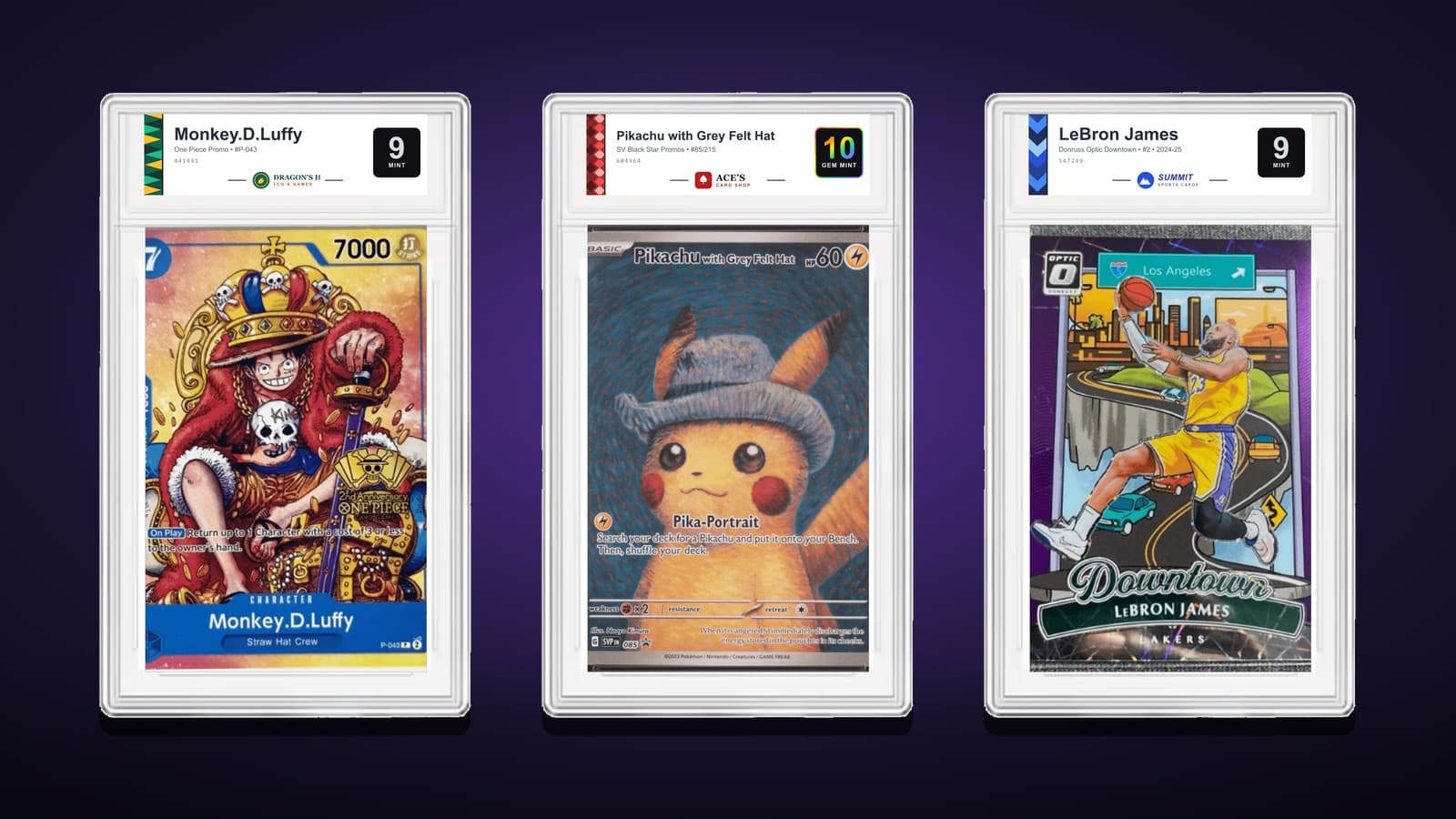
Three custom-branded DCM Enterprise slabs: a One Piece Luffy, a Pikachu with Grey Felt Hat and a LeBron James Downtown
Card shops, show vendors, online sellers and breakers are grading from photos instead of waiting months on a mail-in queue. Here is how the software works and how to judge it.
Quick answer
Collectibles grading software evaluates a trading card from photos of its front and back and returns a condition grade with subgrades, a written report, a printable label and a verification page, usually in about a minute. Card shops, show vendors, online sellers and breakers use it to document condition without mailing cards to a grading company. DCM Optic grades Pokémon, sports, MTG, Lorcana, One Piece and Yu-Gi-Oh! cards for $0.50 to $2.99 each, with Dealer and Enterprise plans from $199 a month for white-label labels and storefronts.
For most of the hobby's history, "grading" meant one thing: mail the card to a company, wait, and get a sealed slab back. Collectibles grading software is the other option that has emerged in the last few years. The card never leaves your hands. You photograph it, software evaluates it, and you get a documented grade in about a minute.
This page explains what the software does, who is using it, what it costs, and how to tell a serious tool from a toy.
What grading software actually does
 Five-step workflow of photo-based grading software: photograph, grade, label, verify, list
- Photograph the card. Front and back, on a phone, a web camera or a bulk upload.
- Grade it. The software scores centering, corners, edges and surface on both faces and writes a report explaining every deduction. On DCM, each card is evaluated three times and the median is published, so one odd evaluation cannot set the grade. The method is on how DCM Optic produces a grade.
- Print a label. Label files sized for standard slabs and holders. Enterprise accounts put their own name, colours and logo on the label.
- Verify. Each label carries a QR code to a public report page with the photos, the subgrades and the reasons. Anyone can check the grade.
- List or display. Push the card to eBay with the grade attached, or show it on a storefront.
What it does not do: authenticate the card, detect a signature's authenticity, or seal the card in a holder. What DCM provides and what you supply draws that line precisely.
Who uses it
 Table of businesses that use grading software, the job each needs done and what DCM provides
- Card shops price trade-ins consistently and showcase stock with a grade and a report, instead of a handwritten "NM" on a penny sleeve.
- Show vendors grade at the table. A buyer who doubts a condition claim can scan the label and read the report, which settles most disputes before they start.
- Online sellers list faster. A grade and a linked report on an eBay listing answers the condition question before the buyer asks it, and DCM's InstaList builds the listing from the report.
- Breakers and streamers grade hits on stream and ship them with a label.
- Grading businesses run their own white-label service on top of the engine, with their branding on every label and a storefront of their graded cards. The custom slabs in the header image are three Enterprise brands' labels on real cards.
What it costs
| Plan | Price | Grades | Per grade |
|---|---|---|---|
| Single credits | $2.99 to $0.66 | 1 to 150 | from $0.66 |
| Card Lovers Annual | $449 a year | 900 | $0.50 |
| Dealer | $199 a month | 400 | $0.50 |
| Enterprise | $399 a month | 1,000 | $0.40 |
Dealer and Enterprise include branded labels, a storefront page and team access. Prices as of October 2026; the current table is on Enterprise and credits.
For comparison, the cheapest open mail-in tier at a major grading company was $20 a card with a 90-business-day estimate in October 2026, plus shipping both ways. The two products are not substitutes: one gives you a sealed, authenticated slab; the other gives you a documented condition grade today. Many businesses use both, grading everything with software and mailing in the few cards that justify a slab.
Six questions to ask before you choose one
- Is the grading standard published? You cannot interpret a grade against a rubric you cannot read. DCM's is at /grading-standard.
- Does it publish its consistency? Ask how often the tool gives the same card the same grade. DCM's repeatability data is public.
- Does it tell you when the photos are not good enough? A grade from a bad photo is a guess. Every DCM report carries an image confidence letter from A to D.
- Is every grade verifiable by a third party? A grade that lives only in your app is a note to yourself. A public report page with a QR code is evidence.
- Does it explain deductions in writing? "Corners 8" is a number. "Noticeable softening at the bottom-left corner on the front" is something a buyer can check.
- What does it refuse to do? A serious tool says plainly that it does not authenticate. See grading limitations.
Where to start
Grade two cards free on dcmgrading.com and read the reports. If the business case is there, the Enterprise page covers white-label labels, storefronts and volume pricing, and the label designer shows what a branded label looks like before you commit.
Prices and plans as of October 2026. DCM does not authenticate cards and does not predict the grade another company would assign.
Frequently asked questions
- What is collectibles grading software?
- Software that evaluates a trading card from photos of its front and back and returns a condition grade with subgrades, a written report, a printable label and a public verification page, typically in about a minute. The card never leaves the owner. It does not authenticate the card or seal it in a holder.
- Who uses card grading software?
- Card shops pricing trade-ins, show vendors documenting condition at the table, online sellers listing with a verifiable grade, breakers grading hits on stream, and grading businesses running a white-label service on top of the engine.
- How much does grading software cost?
- On DCM, single grades run from $2.99 down to $0.66 in packs, Card Lovers Annual is $449 for 900 grades, Dealer is $199 a month for 400 grades and Enterprise is $399 a month for 1,000 grades with branded labels and a storefront. Prices as of October 2026.
- Is software grading as good as a mail-in grading company?
- They do different jobs. A mail-in grader physically examines, authenticates and encapsulates the card. Grading software documents condition from photos in a minute against a published standard. Many businesses use software for every card and mail in only the few that justify a sealed slab.