Card Spotlight: A 1999 Fossil Articuno at DCM Grade 1, and Why Low Grades Are Rarer Than You Think
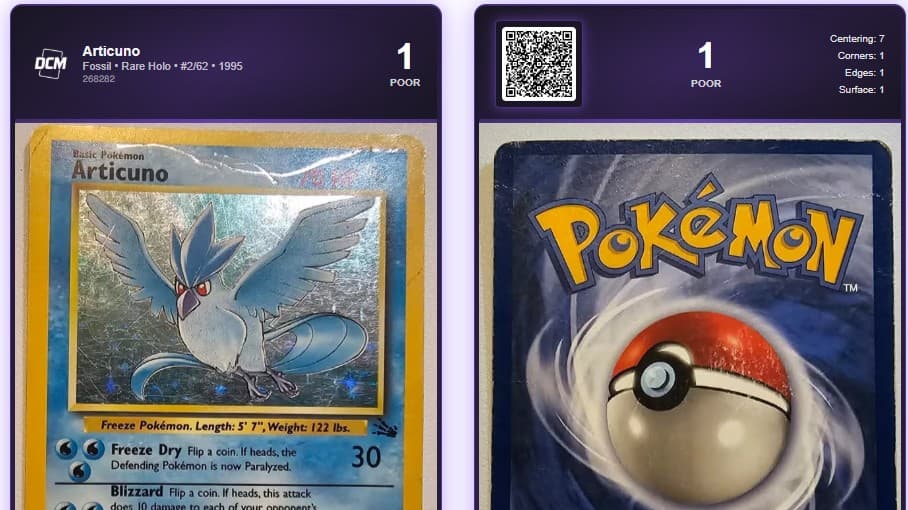
Vintage Pokémon, graded a 1 but still valuable!
Breaking down a beat-up Holo Articuno, the sub-score story, and what pop reports tell us about damaged vintage cards
Quick answer
A heavily played 1999 Fossil Holo Articuno graded a DCM 1, the Poor tier, with worn corners, whitened edges and a scratched surface. Low-grade slabbed copies of vintage cards are often rarer than high-grade ones because almost nobody sends a beat-up card in, which makes population data for grades 1 to 3 surprisingly thin.
Most card spotlights you read are about the perfect ones. The dead-centered, mirror-clean, no-visible-flaws copies that bring the heart rate up at auction. This is not one of those.
This is a 1999 Fossil Articuno that has clearly lived a life. Corners worn down past the print line. Edges whitened from years of being shuffled in and out of binders or pulled in and out of decks. Surface scratched and gouged by what looks like every play session the original owner ever had. We graded it through DCM Optic and the final number came back as a 1, which our system labels Poor. It's one of the lowest grades a card can earn before it stops counting as graded at all.
And honestly, this card might be more interesting at a 1 than it would have been at a 10.
The Card
 Articuno Graded 1 DCM
The 1999 Fossil set was the third major English Pokemon TCG release, hitting shelves in October of that year. Articuno was one of the Holofoil Rares, a Legendary Bird Pokemon with the now-iconic Freeze Dry attack on a glassy etched holo background. For a generation of kids who pulled it out of their first booster packs, it was a chase card. For collectors today, a clean copy is a steady performer with real demand.
Articuno Graded 1 DCM
The 1999 Fossil set was the third major English Pokemon TCG release, hitting shelves in October of that year. Articuno was one of the Holofoil Rares, a Legendary Bird Pokemon with the now-iconic Freeze Dry attack on a glassy etched holo background. For a generation of kids who pulled it out of their first booster packs, it was a chase card. For collectors today, a clean copy is a steady performer with real demand.
Card Details:
- Pokemon: Articuno
- Set: Fossil
- Card Number: 2/62
- Year: 1999
- Manufacturer: Wizards of the Coast
- Rarity: Holofoil Rare
- Type: Water
- HP: 70
View the full grading report and card images on DCM Grading.
How It Graded: DCM 1 (Poor)
A DCM 1 is the floor. In our scale, it means a card with extensive, visible structural and surface damage that significantly affects how the card presents under any lighting. Confidence on this grade came back as Medium, which reflects clear evidence of wear paired with the kind of minor photographic glare that's normal for a holo card under camera light.
What makes this Articuno useful for understanding how grading actually works is the sub-score breakdown.
Sub-Score Breakdown
 Subscores Articuno Grade 1
Look at centering. A 7 on the front and an 8 on the back is honest centering for a vintage Wizards holo. Plenty of higher-graded examples are worse on centering alone. If everything else on this card had held up, the centering would not have been the problem.
But corners, edges, and surface all came in at 1, on both sides of the card. That tells you the whole story.
What DCM Optic Saw
The grade summary picked up the specifics that drove every category down. The bottom-left corner on the front shows substantial material loss, not just rounding. The bottom-right corner on the back has the same kind of structural damage. Both edges show heavy chipping and whitening, the kind that happens when a card gets shuffled into and out of a deck thousands of times without sleeves.
Surface is where holos are especially unforgiving. The holofoil layer takes scratches and gouges very differently from a non-holo surface, and once that mirror finish is compromised, there's no hiding it under any lighting angle. This Articuno has scratching across both the front holofoil and the back artwork, deep enough that it dominates the visual impression of the card.
A card in this condition was not a binder queen. This was someone's actual deck, and it played a lot of games.
Why Grade 1 Cards Can Be Rarer Than Grade 10s
This is the part that catches people off guard the first time they hear it. For some popular vintage cards, the population of pristine high-grade copies is larger than the population of low-grade slabbed copies.
It works like this. When a card came out, most copies fell into one of two paths. Some collectors bought them, kept them clean, never played with them, and stored them carefully. Those are the cards that show up decades later as 9s and 10s. The other path is what happened to this Articuno. It got played, traded, jammed into a backpack pocket, and left on a kitchen table for the dog to chew on.
The consequence is the interesting part. When that second category gets damaged enough, most owners don't bother sending it in for grading. Why pay grading fees on a card that's going to come back as a 2 or a 3? So the population of officially graded low-grade copies stays small while the population of high-grade slabbed copies keeps growing as people send in their best stuff.
You can check this yourself on the PSA Population Report for popular vintage Pokemon holos. For some cards, there are dozens or even hundreds of PSA 9 and PSA 10 copies on record, and a single-digit number of PSA 1 copies. That isn't a market accident. It's the same pattern you see across the hobby.
This doesn't automatically make a Grade 1 card valuable. Demand for damaged copies is thin, and prices reflect that. But it does mean a slabbed Grade 1 of a card you love is a legitimately uncommon collectible in its own right, and it tells a story that a flawless copy never can.
What This Card Is Actually For
There's a kind of collector who specifically wants the worn copies. The "play condition" collector. They're after the cards that were in heavy rotation when the cards were new, the ones that show real history. A pristine 1999 Holo Articuno is a beautiful object. A 1999 Holo Articuno with corner loss and a half-erased holo layer is a relic of an actual kid's actual Pokemon deck from 1999, slabbed up and preserved so that wear cannot get any worse.
Both are worth grading. Both belong in a collection. They just mean different things.
For the original owner of this card, getting it slabbed at a 1 isn't about resale value. It's about freezing the card exactly where it is, with all of its wear intact, so that twenty years from now it still tells the story of a deck that won a few schoolyard matches and got reshuffled until the edges turned white.
The Bottom Line
A Grade 1 is not a failure. It's a complete and honest analysis of a card that lived a real life. Sub-scores on this Fossil Articuno tell you exactly what happened, where the wear is, and how to think about value. The centering was salvageable. The structural damage was not.
If you have cards in your collection that you played with, traded, or pulled out of an old shoebox in your parents' basement, don't skip them. The full grading report is worth seeing, even when the number on the slab is a 1. Sometimes especially when it is a 1.
Want to see what your own cards look like under DCM Optic? Grade a card with DCM Grading and get a full sub-score breakdown, condition analysis, and market context in under two minutes.
Frequently asked questions
- Why would anyone grade a card that scores a 1?
- To document its condition honestly, to keep it in a collection with a label that states what it is, and because slabbed low grades of vintage cards are uncommon enough to interest set collectors.
- What did DCM Optic see on this Articuno?
- Corner wear past the print line, edge whitening from years of handling, and surface scratches and gouges consistent with play. Each is called out in the report with its location.
- Is a 1999 Fossil Articuno valuable in poor condition?
- Far less than a clean copy, but it still has a market. Set builders on a budget and collectors who want the card they played with as kids buy played copies regularly.