Card Spotlight: The 1984 Star #101 Michael Jordan, a $30K Rookie That's Still Climbing
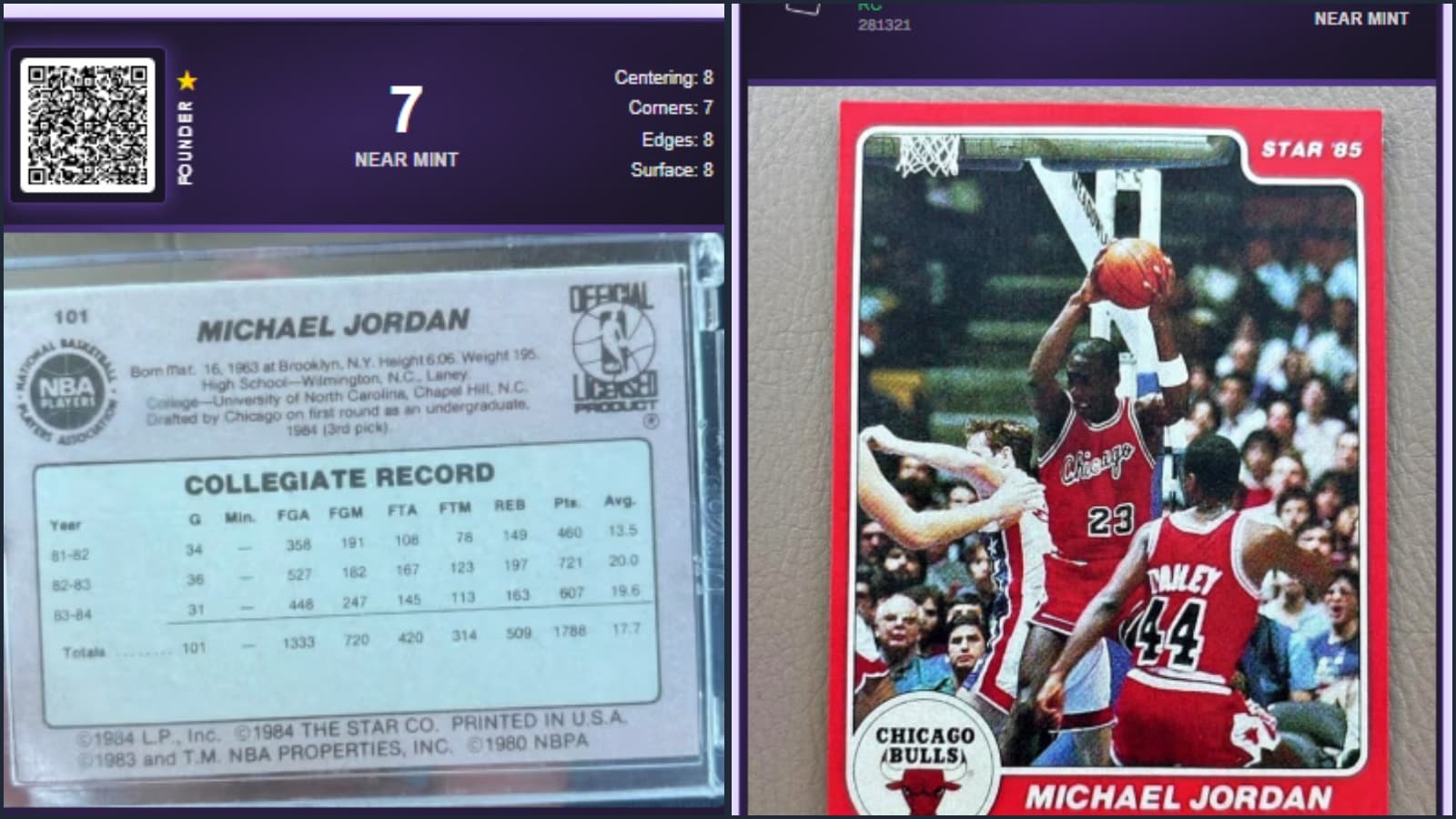
1984 Star #101 Michael Jordan
Breaking down the grade, the market data, and why this pre-Fleer rookie commands serious money
Quick answer
The 1984 Star #101 Michael Jordan is his true rookie card, released two years before the 1986 Fleer and distributed only through hobby dealers in team bags. A copy graded DCM 7 Near Mint carries a market value near $30,000, and PSA 9.5 examples have traded above $118,000.
There are rookie cards, and there are the rookie cards. The 1984 Star #101 Michael Jordan is one of those.
A copy we recently graded through DCM Optic earned a DCM 7, a respectable Near Mint for a 40-year-old hobby-shop release. Even at a mid grade, the market values it at nearly $30,000. In a PSA 9.5, the same card trades north of $118,000.
That spread tells the whole story of high-end vintage collecting in one row.
The short version
- The card: 1984 Star Company #101, Jordan's true rookie, two years before the 1986 Fleer
- Distribution: hobby-dealer team bags only, never sold in retail packs
- Our grade: DCM 7 (Near Mint), confidence B
- Market range: about $23,000 raw to $118,000 in PSA 9.5
- Grading premium: roughly a 62% jump from raw to PSA 7
The card
Before the 1986 Fleer Jordan rookie that most collectors think of first, The Star Company produced what many consider Jordan's true rookie card. The 1984 Star '85 set was distributed only through hobby dealers in team bags. No retail packs, no display boxes, no factory sets. If you wanted one, you knew a dealer.
That distribution model makes surviving copies scarce. Decades of handling by people who had no idea what they were holding makes high-grade examples scarcer still.
Card specs:
| Player | Michael Jordan |
| Set | Star '85 |
| Card # | 101 |
| Year | 1984 |
| Team | Chicago Bulls |
| Position | Guard |
| Rookie card | Yes |
| Manufacturer | The Star Co. |
The card back reads like a scouting report frozen in time:
Born Mar. 16, 1963 at Brooklyn, N.Y. Height 6:06. Weight 195. High School: Wilmington, N.C., Laney. College: University of North Carolina, Chapel Hill, N.C. Drafted by Chicago on first round as an undergraduate, 1984 (3rd pick).
Third pick. Hard to believe anyone passed on him at all.
How it graded: DCM 7
DCM Optic returned a DCM 7 (Near Mint) with a confidence rating of B. The card presents well overall but shows wear consistent with four decades of hobby-shop handling.
For a 1984 Star, a 7 is a strong grade. These cards came in thin team bags and passed through dealers who had no idea they would one day be worth tens of thousands of dollars. Any copy above a 6 means somebody, somewhere, took unusual care of it along the way.
Market value across grades
Based on SportsCardsPro market data at the time of writing, 47 recorded sales across all grades, here is how the card prices:
| Grade | Market value |
|---|---|
| Raw / Ungraded | $23,126 |
| PSA 7 | $37,503 |
| PSA 8 | $72,550 |
| PSA 9 · BGS 9 · SGC 9 | $107,354 |
| PSA 9.5 · BGS 9.5 | $118,089 |
Three things stand out in that table.
The grading premium is large. A raw copy trades around $23,000, but slabbed as a PSA 7 it sits near $37,500, a 62% premium for authentication and a verified grade. At this price, buyers want certainty.
A PSA 7 to a PSA 8 nearly doubles the value. Going from $37,500 to $72,550 is a 93% jump for a single grade point. This is where condition sensitivity kicks in. Every corner, edge and surface flaw moves the number by tens of thousands of dollars.
PSA 9 and above is a different market. At $107,000 for a 9 and $118,000 for a 9.5, these are assets as much as collectibles. PSA, BGS and SGC all converge at the 9 level, which points to broad agreement on what a high-grade example is worth.
Why this card matters
This card is not expensive only because Michael Jordan is on the front. It occupies a unique place in the hobby:
- Limited distribution. A hobby-dealer-only release. Total production is unknown but believed to be far below the 1986 Fleer print run.
- Authentication risk. Star cards have been widely counterfeited over four decades. Buyers pay a premium for graded copies because they are buying certainty as well as condition.
- Historical significance. This is Jordan before six championships, before the flu game, before The Last Dance. A snapshot of pure potential.
- Market resilience. While the broader sports card market corrected after the pandemic-era boom, elite Jordan cards held their value. The 1984 Star #101 has shown steady demand at every grade.
The bottom line
Whether you own a copy, are thinking about buying one, or just like following these markets, the 1984 Star #101 Jordan shows how scarcity, significance and condition compound. A single grade point is the difference between a $37,000 card and a $72,000 card.
At those prices, knowing a card's condition before you buy, sell or send it off for grading is not just useful. It is essential.
Want to know what your cards are worth? Grade your collection with DCM Optic and get a grade with live market data in about a minute.
Frequently asked questions
- Is the 1984 Star Jordan a real rookie card?
- Yes. It predates the 1986 Fleer by two years. It was distributed only through hobby dealers in team bags, never in retail packs, which is why some price guides treated it differently for years.
- Why is the DCM confidence score a B on this card?
- The photos supported the grade but left some areas less clear than an A would require, so the report carries slightly more uncertainty.
- How much does grade change the price on this card?
- Dramatically. The spread runs from roughly $23,000 raw to more than $118,000 in PSA 9.5, and the jump from raw to a PSA 7 alone was about 62 percent at the time of writing.